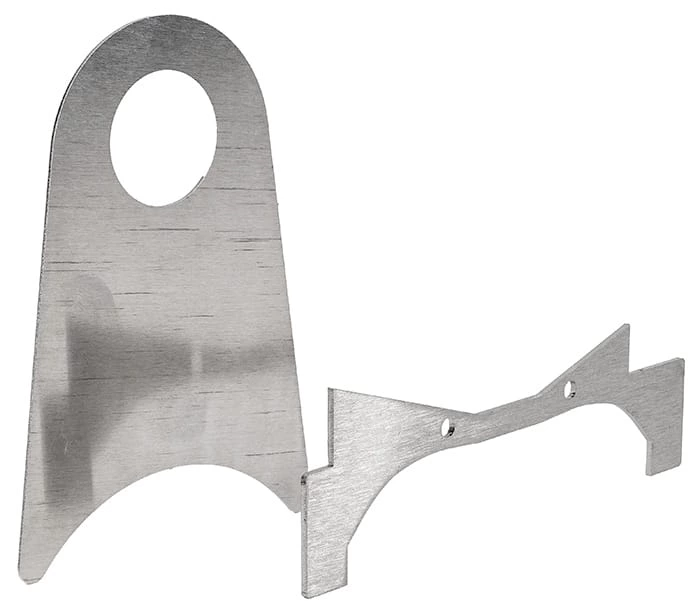
2024 Aluminum: Deep dive into properties, fabrication, and ese cases
2024 aluminum (often “2024 Al” or “Al 2024”) belongs to the 2xxx series of high-strength aluminum alloys. Its copper + magnesium alloying gives it strength that competes with many steels while preserving light weight. That said, it has tradeoffs, primarily corrosion sensitivity and limited weldability. Below is a full breakdown of what designers, engineers, and fabricators should know when using 2024 in laser cut or sheet metal parts.
Key things to know about 2024 Aluminum
- High Strength, Heat-Treatable Alloy: 2024 is one of the stronger aluminum alloys via heat treatment.
- Corrosion Vulnerable: Bare 2024 has lower corrosion resistance than many 5xxx and 6xxx alloys; it’s often clad or coated (Alclad) to protect it.
- Fatigue & Structural Use: Because of excellent fatigue strength, 2024 finds usage in aerospace and high-stress cyclic loads.
- Limited Weldability: The copper content makes welding riskier (cracking, property loss). It’s not as weld-friendly as alloys like 6061.
- Good Machinability: 2024 machines well, producing clean finishes when the correct tools/parameters are used.
Mechanical & physical properties of Al 2024
Understanding where 2024 fits in requires examining the numbers. Here’s a summary (approximate, varies by temper):
- Tensile Strength (Ultimate): ~70,000 psi (depending on temper)
- Yield Strength: ~ 50,000 psi
- Elongation / Ductility: ~ 15%-20% (depending on temper and thickness)
- Hardness: Brinell ~ 120HB
- Density: ~ 0.100 lb/in³ (lightweight like most aluminums)
2024-T3 offers an exceptional strength-to-weight ratio, excellent fatigue performance, and moderate ductility, making it ideal for high-load structural parts. However, its corrosion resistance and weldability are limited, so protective coatings or cladding are recommended in most environments.
Strengths & advantages of 2024 Aluminum
1. Very high specific strength
Among wrought alloys, 2024 is one of the strongest you can get, especially in tension, making it ideal for load-bearing and structural components where weight matters.
2. Excellent fatigue performance
One of 2024’s hallmarks is its ability to withstand cyclic loading. That makes it suitable for applications like aircraft skins, structural brackets, fuselage parts, and high-stress joints.
3. Good machinability
Despite being high strength, 2024 machines reasonably well with the right tooling. You can get tight tolerance features, crisp finishes, and complex geometries when you optimize feeds, speeds, and tooling. And of course, when you have your 2024 aluminum cut at SendCutSend, we handle the feeds, speeds and tooling for you.
4. Heat-treatable
Unlike 5xxx and 6xxx alloys (in many cases), 2024 can be heat treated to enhance strength. That gives flexibility: parts are often formed, then heat-treated to final properties.
5. Premium in high-end applications
Because of its performance envelope, 2024 Aluminum is often chosen in aerospace, defense, robotics, and precision gear/structure applications where materials with mid-strength levels won’t cut it.
Trade-offs & limitations of 2024 Aluminum
1. Corrosion susceptibility
The copper in 2024 reduces its natural corrosion resistance. Without protection, bare 2024 can pit, stress-corrode, or corrode in harsh environments (salt spray, humidity). Many 2024 sheets are clad with a pure-aluminum skin (Alclad) to help protect the core.
2. Difficult or limited weldability
Welding 2024 Aluminum may cause hot cracking, reduced strength at the weld zone, or grain boundary issues. Because of its copper content, 2024 is generally considered more “weld-sensitive.”
3. Lower ductility in comparisons
While 2024 is ductile enough for many designs, it’s less forgiving than softer aluminum alloys like 6061 T6 Aluminum or 7075 T6 Aluminum in bending or forming large deformations. Some tempers may crack under aggressive forming.
4. Performance variation by temper
The same “2024” alloy can perform quite differently depending on temper (T3 vs T4 vs T351), so design assumptions must be conservative or based on exact specs. At SendCutSend we stock 2024 T3 Aluminum.
Fabrication & laser cutting considerations
When fabricating parts in 2024 Aluminum, especially via laser cutting or sheet metal, here’s what to watch for:
Kerf, edge quality & tolerances
- Expect some heat-affected zone near cut edges (since laser imparts thermal energy).
- For critical fits, you may need to allow for bevel, recast layer, or minor edge treatments.
- Tolerance achievable depends on equipment; for SendCutSend we have a +/- .005″ cutting tolerance on 2024 Aluminum
Feature size / hole limitations
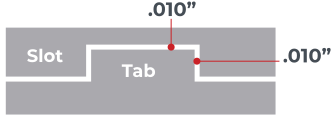
- Avoid extremely small holes or thin slots in thicker sheets; 2024’s higher strength makes cutting narrow features more challenging.
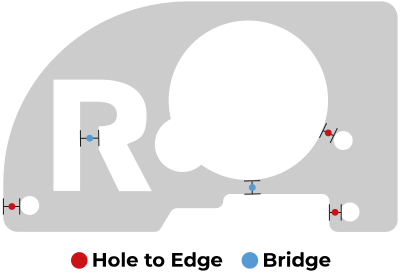
- Keep holes away from edges to avoid stress concentration that can lead to cracks. Design edge clearance rules.
Heat & distortion
- Heat from cutting can warp thin sections. Use careful fixturing and heat control to help.
- Because 2024 is heat-treatable, you don’t want cutting to alter local tempered zones; avoid overheating.
Use cases & applications
Because of its strength, fatigue behavior, and aerospace pedigree, 2024 is used in:
- Aircraft structural parts (skins, wings, fuselage)
- High-stress brackets, mountings, linkages
- Aerospace tooling and fixtures
- Some high-end robotics and aerospace frame components
- Cases where weight vs strength tradeoff leans toward performance over cost
If your design calls for cutting 2024 parts, the justification often comes from needing strength beyond what 6061 or 5052 can reliably supply in that geometry.
Why use 2024 T3 Aluminum?
2024 aluminum offers a performance tier above more common alloys—its strength, fatigue resistance, and ability to be heat-treated make it ideal for structural, high-stress, and aerospace-grade parts. Yet, you accept tradeoffs in corrosion resistance, weldability, and handling complexity. Designers who pick 2024 are often doing serious work. They expect material behavior, tolerances, and finishing to all align.