MIC-6 Cast Aluminum size and thickness options

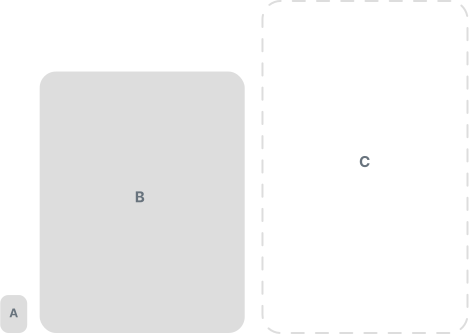
Cut Sizes

  • A..5" x 1.00"minInstant Pricing
  • B.30" x 44"maxInstant Pricing
  • C.44" x 56"max Custom Quot

Thicknesses

Laser cut, +/- .005" tolerance

  • .250" 6.35mm
  • .375" 9.53mm
  • .500" 12.7mm

MIC-6 Cast Aluminum material details and specifications

.250"6.35mm MIC-6 Cast Aluminum

Material Details & Specifications

ALUMIC6 .250" GENERAL DETAILS
Advertised Thickness 0.250"
Gauge N/A
Thickness tolerance positive 0.005"
Thickness tolerance negative 0.005"
Top/Bottom finish Identical both sides
Sourced from Global
LASER CUTTING SPECIFICATIONS
Cutting process Fiber laser
Cut tolerance +/- 0.005"
Flatness tolerance before cutting +/-0.015" per foot
Min part size .500″ x .750″
Max part size 44″ x 30″
Min hole size .060″
Min bridge size .095″
Min hole to edge distance .054″
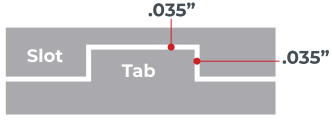
Tab and slot tolerance .035"
COUNTERSINK SPECIFICATIONS
Min countersink part size 1" x 4"
Max countersink part size 14″ x 46″
Countersink Min Minor .099"
Countersink Max Major .656″
Countersink Min Hole Center to Material Edge .338"
DEBURRING SPECIFICATIONS
Min deburring part size 1" x 3"
Max deburring part size 36″ x 46″
TAPPING SPECIFICATIONS
Largest Tap 1/2-20
Smallest Tap 4-40
Min Flat Part Size Tapping 0.949" x 1.5"
Max Flat Part Size Tapping 36" x 46"
Tapping Min Hole to Edge 0.075"
Tapping Min Hole Center to Material Edge Tap hole size/2 +0.075"
MIC-6 Cast Aluminum Tooling Plate
Material Composition Cast aluminum tooling plate, proprietary aluminum-silicon alloy
Density 169.344 lb/ft^3
Heat treatments process N/A (cast, stress relieved)
Finish Machined Top/Bottom
ASTM Proprietary cast tooling plate (Arconic MIC-6)
Tensile Strength (Ultimate) 24 ksi
Tensile Strength (Yield) 15 ksi
Shear Strength 14 ksi
Shear Modulus N/A
Fatigue Strength N/A
Brinell Hardness 65
Elongation at Break 3%
Elastic Modulus 10000 ksi
Poisson’s Ratio .33
Thermal Conductivity 55 BTU/h-ft °F
Melting Point 1080 °F
Magnetic No
Does it Rust No

.375"9.53mm MIC-6 Cast Aluminum

Material Details & Specifications

MIC6 Aluminum .375" GENERAL DETAILS
Advertised Thickness 0.375"
Gauge N/A
Thickness tolerance positive 0.005"
Thickness tolerance negative 0.005"
Top/Bottom finish Identical both sides
Sourced from Global
LASER CUTTING SPECIFICATIONS
Cutting process Fiber laser
Cut tolerance +/- 0.005"
Flatness tolerance before cutting +/-0.015" per foot
Min part size .75″ x 1.00″
Max part size 44″ x 30″
Min hole size .120″
Min bridge size .143″
Min hole to edge distance .108″
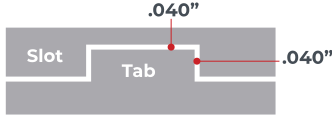
Tab and slot tolerance .040"
COUNTERSINK SPECIFICATIONS
Min countersink part size 1" x 4"
Max countersink part size 14″ x 46″
Countersink Min Minor .130"
Countersink Max Major .656″
Countersink Min Hole Center to Material Edge .338"
DEBURRING SPECIFICATIONS
Min deburring part size 1" x 3"
Max deburring part size 36″ x 46″
TAPPING SPECIFICATIONS
Largest Tap 1/2-20
Smallest Tap 8-32
Min Flat Part Size Tapping 0.949" x 1.5"
Max Flat Part Size Tapping 36" x 46"
Tapping Min Hole to Edge 0.113"
Tapping Min Hole Center to Material Edge Tap hole size/2 +0.113"
MIC-6 Cast Aluminum Tooling Plate
Material Composition Cast aluminum tooling plate, proprietary aluminum-silicon alloy
Density 169.344 lb/ft^3
Heat treatments process N/A (cast, stress relieved)
Finish Machined Top/Bottom
ASTM Proprietary cast tooling plate (Arconic MIC-6)
Tensile Strength (Ultimate) 24 ksi
Tensile Strength (Yield) 15 ksi
Shear Strength 14 ksi
Shear Modulus N/A
Fatigue Strength N/A
Brinell Hardness 65 HB
Elongation at Break 3%
Elastic Modulus 10000 ksi
Poisson’s Ratio .33
Thermal Conductivity 55 BTU/h-ft °F
Melting Point 1080 °F
Magnetic No
Does it Rust No

.500"12.7mm MIC-6 Cast Aluminum

Material Details & Specifications

MIC6 Aluminum .500" GENERAL DETAILS
Advertised Thickness 0.500"
Gauge N/A
Thickness tolerance positive 0.005"
Thickness tolerance negative 0.005"
Mill Finish Machined
Top/Bottom finish Identical both sides
Sourced from Global
LASER CUTTING SPECIFICATIONS
Cutting process Fiber laser
Cut tolerance +/- 0.005"
Flatness tolerance before cutting +/-0.015" per foot
Min part size 1.00″ x 1.00″
Max part size 44″ x 30″
Min hole size .150″
Min bridge size .190″
Min hole to edge distance .135″
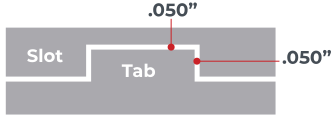
Tab and slot tolerance .050"
COUNTERSINK SPECIFICATIONS
Min countersink part size 1" x 4"
Max countersink part size 14″ x 46″
Countersink Min Minor .193"
Countersink Max Major .656″
Countersink Min Hole Center to Material Edge .338"
DEBURRING SPECIFICATIONS
Min deburring part size 1" x 3"
Max deburring part size 36″ x 46″
TAPPING SPECIFICATIONS
Largest Tap 1/2-20
Smallest Tap 10-32
Min Flat Part Size Tapping 0.949" x 1.5"
Max Flat Part Size Tapping 36" x 46"
Tapping Min Hole to Edge 0.150"
Tapping Min Hole Center to Material Edge Tap hole size/2 +0.150"
MIC-6 Cast Aluminum Tooling Plate
Material Composition Cast aluminum tooling plate, proprietary aluminum-silicon alloy
Density 169.344 lb/ft^3
Heat treatments process N/A (cast, stress relieved)
Finish Machined Top/Bottom
ASTM Proprietary cast tooling plate (Arconic MIC-6)
Tensile Strength (Ultimate) 24 ksi
Tensile Strength (Yield) 15 ksi
Shear Strength 14 ksi
Shear Modulus N/A
Fatigue Strength N/A
Brinell Hardness 65 HB
Elongation at Break 3%
Elastic Modulus 10000 ksi
Poisson’s Ratio .33
Thermal Conductivity 55 BTU/h-ft °F
Melting Point 1080 °F
Magnetic No
Does it Rust No
What is ALUMIC-6?

What is ALUMIC-6?

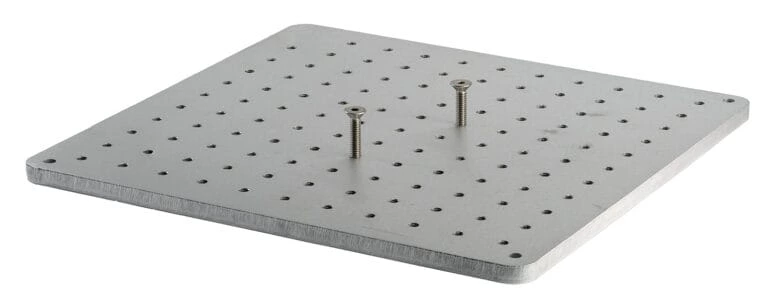
ALUMIC-6 is a precision-machined cast aluminum tooling plate engineered for flatness and dimensional stability rather than strength or formability. Unlike rolled aluminum alloys, ALUMIC-6 has extremely low internal stress, allowing parts to remain flat after laser cutting and machining. This makes it an ideal choice for fixtures, jigs, and tooling where accuracy and repeatability matter most.

What can you make with ALUMIC-6 parts?

When you have a project that requires flat aluminum with stability and minimal warping, ALUMIC-6 is a good choice. It’s most commonly used for the following:

  • CNC fixtures and jigs
  • Tooling plates
  • Machine base plates
  • Inspection fixtures
  • Robotics mounting plates
  • Automation components
  • Precision spacers and adapters
  • Flat mounting surfaces
  • And so much more!

ALUMIC-6 FAQs

SendCutSend carries MIC-6 Cast Aluminum Sheet in .250″ (6.35mm), .375″ (9.53mm), and .500″ (12.7mm) for custom laser cutting

The minimum cut size for ALUMIC-6 is .750″ x 1.00″. Maximum cut size for instant quotes is 30″ x 44″.

We offer deburring, countersinking, and tapping services for ALUMIC-6 sheet.

Start your first Metal Manufacturing project today!

Upload your CAD design, or try one of our customizable part templates to get instant pricing on your custom laser cut parts. All delivered to your door in a matter of days.

Waterjet

Upload a CAD file

We accept .ai, .dxf, .dwg, .eps, .stp, and .step

Start Your Quote

MIC-6 cast aluminum tooling plate: Precision ground, stress relieved aluminum for machining and fixturing

MIC-6 is a cast aluminum tooling plate specifically engineered for dimensional stability, flatness, and excellent machinability. Unlike rolled aluminum sheet such as 5052 or 6061, MIC-6 is cast, stress relieved, and precision ground to tight flatness tolerances. This makes it ideal for fixtures, jigs, base plates, mounting plates, machine components, and applications where flatness and stability matter more than high structural strength.

At SendCutSend, we laser cut MIC-6 cast aluminum in .250 inch, .375 inch, and .500 inch thicknesses to ±.005 inch tolerance.

What are the key things to know about MIC-6 cast aluminum?

  • Cast aluminum tooling plate with superior flatness
  • Stress relieved for dimensional stability
  • Precision ground on both sides
  • Excellent machinability
  • Ideal for fixtures, jigs, and base plates

What is MIC-6 aluminum and how is it different from 6061 or 5052?

MIC-6 is a cast aluminum tooling plate, not a rolled sheet product. The casting process allows for uniform internal structure and stress relief, which improves flatness and reduces movement during machining.

Compared to 6061 aluminum:

  • MIC-6 is cast, 6061 is rolled
  • MIC-6 offers better flatness than 6061
  • MIC-6 has less internal stress than 6061
  • 6061 is stronger structurally than MIC-6
  • 6061 is better for load-bearing parts than MIC-6

Compared to 5052 aluminum:

  • MIC-6 is more stable during machining than 5052
  • 5052 is better for forming and bending than MIC-6
  • MIC-6 is better for flat mounting surfaces than 5052
  • 5052 is more corrosion resistant in marine environments than MIC-6

MIC-6 is typically chosen when flatness and machinability are more important than ultimate strength.

Why do machinists choose MIC-6 for tooling plates and fixtures?

Machinists and engineers frequently choose MIC-6 because it reduces the risk of part distortion during machining.

Reasons MIC-6 is preferred:

  • Stress relieved material reduces warping
  • Excellent dimensional stability
  • Consistent internal structure
  • Flat and parallel surfaces
  • Machines easily with less tool wear
  • Minimal movement after material removal

For fixture plates, vacuum tables, base plates, and machine components, stability is critical. MIC-6 performs exceptionally well in these applications.

How flat is MIC-6 cast aluminum?

Flatness is one of the main selling points of MIC-6.

Because it is cast and precision ground, MIC-6:

  • Has superior flatness compared to rolled plate
  • Maintains parallel surfaces
  • Reduces the need for secondary surfacing
  • Minimizes bowing after machining
  • Maintains tight tolerances over larger surface areas

This makes it ideal for mounting precision components or building machine bases.

How well does MIC-6 machine?

MIC-6 machines very well because:

  • It has a fine, consistent grain structure
  • It produces clean chips
  • It reduces cutter chatter
  • It holds tolerances well
  • It drills and taps cleanly
  • It performs well in pocketing operations

Compared to 6061, MIC-6 often produces less stress-related movement when large amounts of material are removed.

This is especially important when machining large flat plates or creating precision alignment surfaces.

How does MIC-6 perform in structural applications?

MIC-6 is not typically selected for structural load-bearing parts.

Compared to 6061 or 7075 Aluminum:

  • MIC-6 has lower tensile strength
  • MIC-6 is not intended for high stress structural use
  • 6061 is stronger and more versatile for structural components
  • 7075 is significantly stronger for aerospace or high load applications

MIC-6 should be selected for stability and flatness, not maximum strength.

What are the advantages of using MIC-6 cast aluminum?

Excellent dimensional stability

Stress relieved casting reduces internal stresses that cause warping.

Superior flatness

Precision ground surfaces save machining time.

Great machinability

Tools last longer and parts machine cleanly.

Reduced distortion

Large pocketing operations result in less movement compared to rolled plate.

Ideal for fixtures and base plates

Flatness and stability make it well suited for machine setups.

What are the limitations of MIC-6 aluminum?

Not ideal for bending or forming

Cast aluminum is not designed for forming operations.

Lower strength than 6061 and 7075

It should not replace structural alloys in high load designs.

Not commonly welded

Welding cast plate is generally not recommended for precision applications.

Slightly different surface appearance

Cast plate has a different surface finish than rolled sheet.

Cost may be higher than standard rolled aluminum

The casting and grinding process adds value but also cost.

How well does MIC-6 laser cut?

Laser cutting MIC-6 produces clean edges and accurate profiles.

At SendCutSend, MIC-6 is laser cut to:

  • ±.005 inch tolerance
  • Clean outer profiles
  • Accurate hole placement
  • Consistent edge quality
  • Minimal burr formation

SendCutSend offers the following secondary operations on Mic6 parts:

How should I design parts in MIC-6 for laser cutting and machining?

Recommended design practices for MIC-6:

  • Maintain hole sizes appropriate for .250 inch, .375 inch, or .500 inch thickness
  • Avoid extremely sharp internal corners
  • Add fillets for internal cutouts
  • Plan for post-cut machining operations
  • Consider final flatness requirements
  • Leave machining allowance where necessary
  • Avoid designing for bending

For general sheet design rules:
https://sendcutsend.com/guidelines

What are the most common uses for MIC-6 aluminum plate?

MIC-6 is widely used in precision environments. Typical applications include:

  • CNC fixture plates
  • Vacuum tables
  • Machine bases
  • Mounting plates
  • Jig plates
  • Inspection fixtures
  • Assembly tooling
  • Router tables
  • Test stands
  • Automation equipment components

It is also used in manufacturing cells where flat, stable platforms are required.

Is MIC-6 cut and produced in the USA?

MIC-6 aluminum sheets are precision laser cut in SendCutSend’s U.S. facilities:

  • Reno, Nevada
  • Paris, Kentucky
  • Arlington, Texas

Orders ship in 2 to 4 days, making it easy to source precision tooling plate quickly.

When should I use MIC-6 cast aluminum instead of 6061?

Choose MIC-6 when your project requires:

  • High flatness
  • Dimensional stability
  • Minimal movement during machining
  • Fixture or tooling applications
  • Base plates and mounting platforms
  • Large surface areas that must remain stable

Choose 6061 when your project requires:

  • Structural strength
  • Welding
  • Load bearing capacity
  • General purpose aluminum use

MIC-6 is not a replacement for structural aluminum alloys. It is a precision tooling plate designed for stability and machinability.

SendCutSend laser cuts MIC-6 cast aluminum in .250 inch, .375 inch, and .500 inch thicknesses to ±.005 inch tolerance, giving machinists and engineers precision blanks ready for high accuracy applications.
KH-TAT Electronic

Tell Us Your Requirements

For more information about KH-TAT Electronic CNC Tool’s cutting tool solutions, including standard and custom carbide drills, end mills, coatings, and machining support, please feel free to contact our team.
  • Email Brian@wjwanjia.com
  • WhatsApp +86 18967883827
  • Address No. 26, Fenghuang Second Street, Yongchuan District, Chongqing (within Fenghuang Lake Industrial Park, Yongchuan Industrial Park, Chongqing)

    Room 2008, North Building, Yinzhou Chamber of Commerce Building, Yinzhou District, Ningbo City, Zhejiang Province

    Nong Bon Daeng 13, Nong Bon Daeng, Ban Bang Xian, Chon buri 20170, Thailand

This site uses cookies

We use cookies to collect information about how you use this site. We use this information to make the website work as well as possible and improve our services.more details