| Chipboard 0.030" General Details | |
|---|---|
| Advertised Thickness | 0.030" |
| Gauge | N/A |
| Thickness tolerance positive | 0.015" |
| Thickness tolerance negative | 0.015" |
| Top/Bottom finish | Identical both sides |
| Sourced from | USA |
| LASER CUTTING SPECIFICATIONS | |
| Cutting process | Co2 laser |
| Cut tolerance +/- | 0.009" |
| Flatness tolerance before cutting | +/-0.030 per foot |
| Min part size | .25″ x .375″ |
| Max part size | 26″ x 20″ |
| Min hole size | .020″ |
| Min bridge size | .023″ |
| Min hole to edge distance | .020″ |
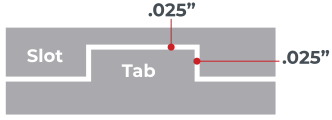
| Tab and slot tolerance | .025" |
 |
|
| Chipboard PROPERTIES | |
| Material Composition | Chipboard Fiberboard, also known as particleboard, is an engineered wood product made from wood chips, sawmill shavings, or sawdust, and a synthetic resin or other suitable binder, which is pressed and extruded. |
| Density | 42 lb/ft^3 |
| Thermal Conductivity | 0.6 BTU/h-ft °F |
| Magnetic | No |
| Does it Rust | No |
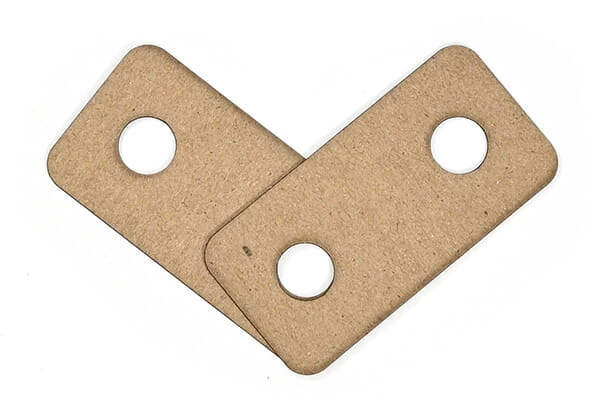
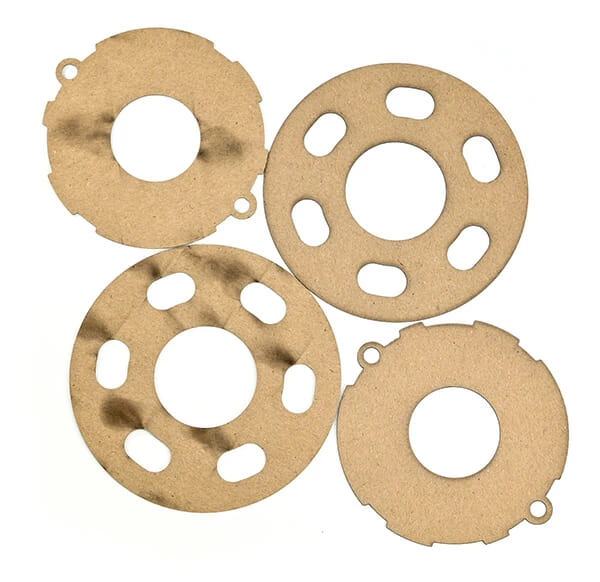

Laser-Cut Chipboard: Lightweight, cost-effective material for templates, packaging, and prototyping
Chipboard is a lightweight, paper-based fiberboard used for everything from packaging and stencils to craft projects, prototyping, and low-cost structural mock-ups. It’s thin, smooth, affordable, and extremely easy to laser cut, making it a popular choice among designers, product developers, educators, and makers. At SendCutSend, we laser cut USA-sourced .030” chipboard to ±.009” tolerance, ideal for templates, packaging inserts, folding prototypes, tags, signage, craft components, and early-stage product mock-ups.
What are the key things to know about chipboard?
- Lightweight and easy to cut: perfect for small, intricate laser-cut designs.
- Smooth surface: great for printing, painting, stamping, and marking.
- Flexible and bendable: can be creased, folded, or scored for packaging or modeling.
- Eco-friendly: typically made from recycled paper fibers.
- Cost-effective: ideal for prototypes, single-use components, or high-volume craft pieces.
Why do fabricators and designers use chipboard for templates and prototypes?
Chipboard is a go-to material for templates and prototypes because it’s affordable, clean-cutting, and fast, making it ideal for early design iterations or parts that don’t require rigidity or long-term durability. People choose chipboard because:
- It laser cuts extremely well with smooth, crisp edges.
- It’s affordable for rapid prototyping or mass crafting.
- It’s easy to draw on, print on, or label.
- It folds cleanly when scored.
- It’s rigid enough for templates but flexible enough for models.
- It’s recyclable and lightweight for shipping or bulk production.
Common uses include:
- Pattern-making
- Packaging mock-ups
- Stencils and templates
- Tags, labels, and signage
- Model-making and architectural studies
- Scrapbooking and craft components
- Low-cost jigs or layout tools
Chipboard is often the first material chosen when someone needs a to prototype a quick, testable physical version of a design before moving to wood, acrylic, or plastic.
How well does chipboard laser cut?
Chipboard laser cuts extremely cleanly because it is thin, consistent, and low-density. This is one of the most frequent search questions, and the answer is overwhelmingly positive.
What to expect from laser cut-chipboard:
- Very crisp edges with minimal char
- Clean internal detail for fine stencils or lettering
- Minimal smoke residue (easily wiped or sanded)
- Extremely tight geometry because the material is so thin
- Fast cut speeds leading to lower cost
Laser cutting is the best possible method for chipboard. CNC routing or mechanical cutting would be too rough or imprecise.
What are the advantages of using chipboard?
1. Chipboard is very cost-effective
Chipboard is inexpensive, making it ideal for:
- Test-fitting prototypes
- Mass production of small pieces
- Mock-ups
- Single-use templates
- Classroom or education projects
2. Chipboard is easy to modify, score, and finish
Chipboard can be:
- Scored with a blade
- Folded or bent
- Printed on
- Painted or marked
- Laminated or glued
This gives it versatility unmatched by many plastics or woods.
3. Chipboard is lightweight for shipping
Perfect for product packaging prototypes, craft kits, or instructions.
4. Chipboard is environmentally friendly
Chipboard is typically made from recycled fiber and is recyclable, making it appealing for eco-conscious projects.
5. Chipboard is great for intricate designs
Because it is .030” thick, it can receive very fine laser cut detail that thicker materials cannot achieve.
What are the limitations or drawbacks of chipboard?
Chipboard is useful, but it has clear limitations. These are questions people frequently ask online:
1. Not water-resistant
Chipboard absorbs moisture, swells, and loses strength if wet. If water resistance is needed, consider using:
2. Not structurally strong
Chipboard cannot support load or weight and is not suitable for mechanical parts. For stronger sheet materials:
3. Burn marks may appear on edges
Some light darkening is unavoidable with laser cutting, though minimal.
4. Not suitable for long-term outdoor use
Sun, humidity, and temperature changes degrade chipboard.
5. Thin and flexible
Chipboard is not ideal for precision assemblies that require stiffness or dimensional stability.
How should I design parts for chipboard?
Chipboard is forgiving, but best results come from following a few design principles.
Recommended design practices:
Keep thin walls proportional: Because chipboard is thin, features smaller than 0.06–0.08” may weaken or tear. Use rounded internal corners: Fillets reduce stress concentration and improve cutting quality. Add tabs carefully: Tab-and-slot constructions work, but ensure tabs are not too thin or fragile. Avoid extremely tight press fits: Chipboard compresses slightly; allow tolerance for friction-fit designs. Design for low load: Chipboard is best used for templates, decorative elements, or low-strength components, not for parts carrying load or repeated mechanical stress. Use engraving lightly: Light scoring is fine for fold lines but deep engraving weakens the sheet. Check out SendCutSend design guidelines for more tips on preparing your file for cutting with SendCutSend.
Where is chipboard most commonly used?
Chipboard is found across packaging, design, and maker communities. Common applications include:
- Packaging mock-ups and inserts
- Stencils and art templates
- Scrapbooking and craft components
- Architectural and industrial models
- Business cards, tags, and signage
- Instruction sheets and educational tools
- Pattern-making for sewing, leatherwork, and woodworking
- Low-cost jigs and layout guides
It is especially popular among makers, product designers, educators, and artists due to its affordability and versatility.
Is chipboard from SendCutSend made in the USA?
Chipboard offered by SendCutSend is USA-sourced, ensuring consistent sheet quality and reliability across batches. All cutting, inspection, and fulfillment of chipboard parts take place in our three U.S. manufacturing facilities:
- Reno, Nevada
- Paris, Kentucky
- Arlington, Texas
This provides fast lead times, predictable cutting quality, and secure material availability.
When should I use chipboard for my project?
Use chipboard when you need a thin, lightweight, cost-effective board for prototypes, templates, packaging designs, or craft work — especially when fine laser-cut detail is important. Chipboard is the right choice if your part requires:
- Sharp, clean laser-cut geometry
- Simple folding or creasing
- Low cost for high-volume production
- Lightweight handling or shipping
- A writable, printable, or drawable surface
- Eco-friendly, recyclable material
Chipboard is not the right choice for:
- Outdoor use
- Structural parts
- Mechanical components
- Parts exposed to moisture or heavy wear
SendCutSend laser cuts USA-sourced .030” chipboard to ±.009” tolerance, giving you fast, clean, consistent parts for prototyping and creative projects.