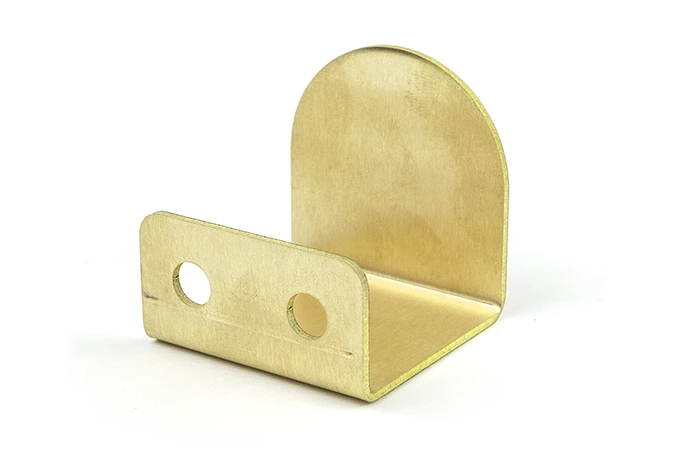
Brass size and thickness options

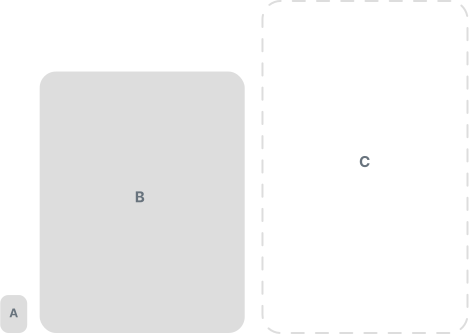
Cut Sizes

  • A..25" x .375"min Instant Pricing
  • B.30" x 44"max Instant Pricing
  • C.34" x 56"max Custom Quote
Thicknesses

Laser cut, +/- .005" tolerance

  • .040" 1.02mm
  • .063" 1.60mm
  • .125" 3.18mm
  • .187" 4.75mm
  • .250" 6.35mm

Brass material details and specifications

.040"1.02mm Brass

Material Details & Specifications

C260 BRASS .040" GENERAL DETAILS
Advertised Thickness 0.040"
Gauge 18
Thickness tolerance positive 0.002"
Thickness tolerance negative 0.002"
Mill Finish N/A
Top/Bottom finish Identical both sides
Sourced from USA/Global
LASER CUTTING SPECIFICATIONS
Cutting process Fiber laser
Cut tolerance +/- 0.005"
Flatness tolerance before cutting +/-0.030 per foot
Min part size .25″ x .375″
Max part size 44″ x 30″
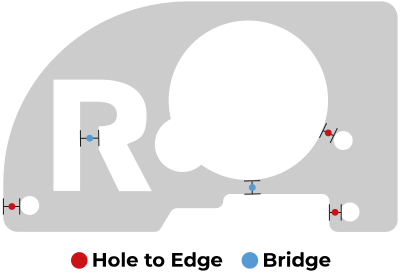
Min hole size .016″
Min bridge size .020″
Min hole to edge distance .020″
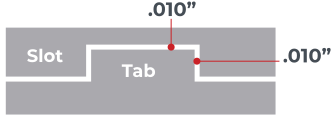
Tab and slot tolerance .010"
BENDING SPECIFICATIONS
Min bend part size .375" x 1.5"
Max bending flat part size 44" x 30"
Max bend length 44"
Min flange length (before bend/Flat Pattern) 90° or less (obtuse) 0.255"
Min flange length (after bend) 90° or less (obtuse) 0.292"
Minimum Length Center of bend line 91-130* (Acute) 0.332"
Die width 0.472"
Effective bend radius @ 90° 0.040"
Max bend angle 130°
Bend angle tolerance (bend length up to 24″) +/- 1 degree
Bend angle tolerance (bend length over 24″) +/- 2 degrees
Bend deduction @ 90° 0.074"
K Factor 0.38
Bend relief depth 0.100"
Minimum joggle. Bend line to bend line @90° max flange 0.299"
Maximum joggle. Bend line to bend line @90° max flange 3.750"
C260 BRASS .040" PROPERTIES
Material Composition Copper (Cu): 68.5 - 71.5% Zinc (Zn): 28.5 - 31.5% Lead (Pb): 0.07% max Iron (Fe): 0.05% max Phosphorus (P): 0.07% max Residuals: 0.5% max
Density 535.680 lb/ft^3
Heat treatments process N/A
ASTM B36-18/B248-12
Tensile Strength (Ultimate) 43 ksi
Tensile Strength (Yield) 18 ksi
Shear Strength 29 ksi
Shear Modulus 6 ksi
Fatigue Strength 18 ksi
Brinell Hardness 80
Elongation at Break 55%
Elastic Modulus 15000 ksi
Poisson’s Ratio .34
Thermal Conductivity 67.7 BTU/h-ft °F
Melting Point 1990 °F
Magnetic No
Does it Rust No

.063"1.60mm Brass

Material Details & Specifications

C260 BRASS .063" GENERAL DETAILS
Advertised Thickness 0.063"
Gauge 14
Thickness tolerance positive 0.006"
Thickness tolerance negative 0.006"
Mill Finish N/A
Top/Bottom finish Identical both sides
Sourced from USA/Global
LASER CUTTING SPECIFICATIONS
Cutting process Fiber laser
Cut tolerance +/- 0.005"
Flatness tolerance before cutting +/-0.030 per foot
Min part size .25″ x .375″
Max part size 44″ x 30″
Min hole size .025″
Min bridge size .032″
Min hole to edge distance .020″
Tab and slot tolerance .010"
BENDING SPECIFICATIONS
Min bend part size .375" x 1.5"
Max bending flat part size 44" x 30"
Max bend length 44"
Min flange length (before bend/Flat Pattern) 90° or less (obtuse) 0.255"
Min flange length (after bend) 90° or less (obtuse) 0.308"
Minimum Length Center of bend line 91-130* (Acute) 0.332"
Die width 0.472"
Effective bend radius @ 90° 0.040"
Max bend angle 130°
Bend angle tolerance (bend length up to 24″) +/- 1 degree
Bend angle tolerance (bend length over 24″) +/- 2 degrees
Bend deduction @ 90° 0.105"
K Factor 0.38
Bend relief depth 0.123"
Minimum joggle. Bend line to bend line @90° max flange 0.324"
Maximum joggle. Bend line to bend line @90° max flange 3.750"
DEBURRING SPECIFICATIONS
Min deburring part size 1" x 3"
Max deburring part size 36″ x 46″
TAPPING SPECIFICATIONS
Largest Tap M6 x 1.0
Smallest Tap M2 x 0.4
Min Flat Part Size Tapping 0.949" x 1.5"
Max Flat Part Size Tapping 36" x 46"
Tapping Min Hole to Edge 0.020"
Tapping Min Hole Center to Material Edge Tap hole size/2 +0.020"
C260 BRASS .063" PROPERTIES
Material Composition Copper (Cu): 68.5 - 71.5% Zinc (Zn): 28.5 - 31.5% Lead (Pb): 0.07% max Iron (Fe): 0.05% max Phosphorus (P): 0.07% max Residuals: 0.5% max
Density 535.680 lb/ft^3
Heat treatments process N/A
ASTM B36-18/B248-12
Tensile Strength (Ultimate) 43 ksi
Tensile Strength (Yield) 18 ksi
Shear Strength 39 ksi
Shear Modulus 6 ksi
Fatigue Strength 18 ksi
Brinell Hardness 80
Elongation at Break 55%
Elastic Modulus 15000 ksi
Poisson’s Ratio .34
Thermal Conductivity 67.7 BTU/h-ft °F
Melting Point 1990 °F
Magnetic No
Does it Rust No

.125"3.18mm Brass

Material Details & Specifications

C260 BRASS .125" GENERAL DETAILS
Advertised Thickness 0.125"
Gauge 8
Thickness tolerance positive 0.008"
Thickness tolerance negative 0.008"
Mill Finish Cold Rolled
Top/Bottom finish Identical both sides
Sourced from USA/Global
LASER CUTTING SPECIFICATIONS
Cutting process Fiber laser
Cut tolerance +/- 0.005"
Flatness tolerance before cutting +/-0.030 per foot
Min part size .25″ x .375″
Max part size 44″ x 30″
Min hole size .045″
Min bridge size .045″
Min hole to edge distance .038″
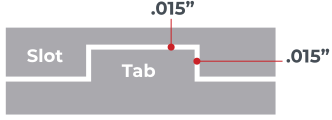
Tab and slot tolerance .015"
BENDING SPECIFICATIONS
Min bend part size .375" x 1.5"
Max bending flat part size 44" x 30"
Max bend length 44"
Min flange length (before bend/Flat Pattern) 90° or less (obtuse) 0.368"
Min flange length (after bend) 90° or less (obtuse) 0.471"
Minimum Length Center of bend line 91-130* (Acute) 0.478
Die width 0.630"
Effective bend radius @ 90° 0.060"
Max bend angle 130°
Bend angle tolerance (bend length up to 24″) +/- 1 degree
Bend angle tolerance (bend length over 24″) +/- 2 degrees
Bend deduction @ 90° 0.205"
K Factor 0.36
Bend relief depth 0.205"
Minimum joggle. Bend line to bend line @90° max flange 0.506"
Maximum joggle. Bend line to bend line @90° max flange 3.750"
DEBURRING SPECIFICATIONS
Min deburring part size 1" x 3"
Max deburring part size 36″ x 46″
TAPPING SPECIFICATIONS
Largest Tap M10 x 1.5
Smallest Tap M2 x 0.4
Min Flat Part Size Tapping 0.949" x 1.5"
Max Flat Part Size Tapping 36" x 36"
Tapping Min Hole to Edge 0.038"
Tapping Min Hole Center to Material Edge Tap hole size/2 +0.038"
TUMBLE SPECIFICATIONS
Min Part Size Tumbling 0.5″ x 1.5″
Max Part Size Tumbling 4″ x 7″
C260 BRASS .125" PROPERTIES
Material Composition Copper (Cu): 68.5 - 71.5% Zinc (Zn): 28.5 - 31.5% Lead (Pb): 0.07% max Iron (Fe): 0.05% max Phosphorus (P): 0.07% max Residuals: 0.5% max
Density 536.680 lb/ft^3
Heat treatments process N/A
ASTM B36-18/B248-12
Tensile Strength (Ultimate) 43 ksi
Tensile Strength (Yield) 18 ksi
Shear Strength 29 ksi
Shear Modulus 6 ksi
Fatigue Strength 18 ksi
Brinell Hardness 80
Elongation at Break 55%
Elastic Modulus 15000 ksi
Poisson’s Ratio .34
Thermal Conductivity 67.7 BTU/h-ft °F
Melting Point 1990 °F
Magnetic No
Does it Rust No

.187"4.75mm Brass

Material Details & Specifications

C260 BRASS .187" GENERAL DETAILS
Advertised Thickness 0.187"
Gauge N/A
Thickness tolerance positive 0.010"
Thickness tolerance negative 0.010"
Mill Finish N/A
Top/Bottom finish Identical both sides
Sourced from USA/Global
LASER CUTTING SPECIFICATIONS
Cutting process Fiber laser
Cut tolerance +/- 0.005"
Flatness tolerance before cutting +/-0.030 per foot
Min part size .25″ x .375″
Max part size 44″ x 30″
Min hole size .055″
Min bridge size .055″
Min hole to edge distance .056″
Tab and slot tolerance .015"
BENDING SPECIFICATIONS
Min bend part size .375" x 1.5"
Max bending flat part size 44" x 30"
Max bend length 44"
Min flange length (before bend/Flat Pattern) 90° or less (obtuse) 0.620"
Min flange length (after bend) 90° or less (obtuse) 0.782"
Minimum Length Center of bend line 91-130* (Acute) N/A
Die width 0.984"
Effective bend radius @ 90° 0.095"
Max bend angle 90°
Bend angle tolerance (bend length up to 24″) +/- 1 degree
Bend angle tolerance (bend length over 24″) +/- 2 degrees
Bend deduction @ 90° 0.324"
K Factor 0.38
Bend relief depth 0.302"
Minimum joggle. Bend line to bend line @90° max flange 0.826"
Maximum joggle. Bend line to bend line @90° max flange 3.750"
DEBURRING SPECIFICATIONS
Min deburring part size 1" x 3"
Max deburring part size 36″ x 46″
TAPPING SPECIFICATIONS
Largest Tap 1/2-20
Smallest Tap M2 x 0.4
Min Flat Part Size Tapping 0.949" x 1.5"
Max Flat Part Size Tapping 36" x 46"
Tapping Min Hole to Edge 0.056"
Tapping Min Hole Center to Material Edge Tap hole size/2 +0.056"
TUMBLE SPECIFICATIONS
Min Part Size Tumbling 0.5″ x 1.5″
Max Part Size Tumbling 4″ x 7″
C260 BRASS .187" PROPERTIES
Material Composition Copper (Cu): 68.5 - 71.5% Zinc (Zn): 28.5 - 31.5% Lead (Pb): 0.07% max Iron (Fe): 0.05% max Phosphorus (P): 0.07% max Residuals: 0.5% max
Density 535.680 lb/ft^3
Heat treatments process N/A
ASTM B36-18/B248-12
Tensile Strength (Ultimate) 43 ksi
Tensile Strength (Yield) 18 ksi
Shear Strength 29 ksi
Shear Modulus 6 ksi
Fatigue Strength 18 ksi
Brinell Hardness 80
Elongation at Break 55%
Elastic Modulus 15000 ksi
Poisson’s Ratio .34
Thermal Conductivity 67.7 BTU/h-ft °F
Melting Point 1990 °F
Magnetic No
Does it Rust No

.250"6.35mm Brass

Material Details & Specifications

C260 BRASS .250" GENERAL DETAILS
Advertised Thickness 0.250"
Gauge N/A
Thickness tolerance positive 0.012"
Thickness tolerance negative 0.012"
Mill Finish N/A
Top/Bottom finish Identical both sides
Sourced from USA/Global
LASER CUTTING SPECIFICATIONS
Cutting process Fiber laser
Cut tolerance +/- 0.005"
Flatness tolerance before cutting +/-0.030 per foot
Min part size .25″ x .375″
Max part size 44″ x 30″
Min hole size .089″
Min bridge size .100″
Min hole to edge distance .075″
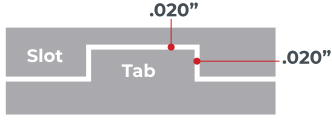
Tab and slot tolerance .020"
BENDING SPECIFICATIONS
Min bend part size .375" x 1.5"
Max bending flat part size 44" x 30"
Max bend length 44"
Min flange length (before bend/Flat Pattern) 90° or less (obtuse) 1.150"
Min flange length (after bend) 90° or less (obtuse) 1.362"
Minimum Length Center of bend line 91-130* (Acute) N/A
Die width 1.575"
Effective bend radius @ 90° 0.130"
Max bend angle 90°
Bend angle tolerance (bend length up to 24″) +/- 1 degree
Bend angle tolerance (bend length over 24″) +/- 2 degrees
Bend deduction @ 90° 0.424"
K Factor 0.38
Bend relief depth 0.400"
Minimum joggle. Bend line to bend line @90° max flange 1.425"
Maximum joggle. Bend line to bend line @90° max flange 3.750"
DEBURRING SPECIFICATIONS
Min deburring part size 1" x 3"
Max deburring part size 36″ x 46″
TAPPING SPECIFICATIONS
Largest Tap 1/2-20
Smallest Tap 4-40
Min Flat Part Size Tapping 0.949" x 1.5"
Max Flat Part Size Tapping 36" x 46"
Tapping Min Hole to Edge 0.075"
Tapping Min Hole Center to Material Edge Tap hole size/2 +0.075"
TUMBLE SPECIFICATIONS
Min Part Size Tumbling 0.5″ x 1.5″
Max Part Size Tumbling 4″ x 7″
C260 BRASS .250" PROPERTIES
Material Composition Copper (Cu): 68.5 - 71.5% Zinc (Zn): 28.5 - 31.5% Lead (Pb): 0.07% max Iron (Fe): 0.05% max Phosphorus (P): 0.07% max Residuals: 0.5% max
Density 535.680 lb/ft^3
Heat treatments process N/A
ASTM B36-18/B248-12
Tensile Strength (Ultimate) 43 ksi
Tensile Strength (Yield) 18 ksi
Shear Strength 29 ksi
Shear Modulus 6 ksi
Fatigue Strength 18 ksi
Brinell Hardness 80
Elongation at Break 55%
Elastic Modulus 15000 ksi
Poisson’s Ratio .34
Thermal Conductivity 67.7 BTU/h-ft °F
Melting Point 1990 °F
Magnetic No
Does it Rust No
 What is Brass?

What is Brass?

Our laser cut brass is gorgeous, easy to form, bend, and machine. This makes it the perfect material for your smaller hinges, locks, and other fasteners well-suited to brass usage.

Brass prevents bacterial growth due to its innate antimicrobial properties. It’s great for applications that are exposed to handling, such as bathroom fixtures.

What can you make with Brass parts?

Additionally, unlike steel and iron, brass will not rust when used in external applications, and that makes it great for signage and decorative displays. However, if you intend to use it this way, it’s important to note that it will corrode with moisture, specifically in the form of tarnish.

Brass is a combination of copper and zinc (with a few other trace elements), and the tarnishing effect is similar to copper.

SendCutSend’s brass cutting service will provide beautiful parts made to your specifications.

  • Locks
  • Hinges
  • Gears
  • Bearings
  • Valves
  • Electrical sockets
  • Hose couplings
  • Ammunition casings
  • And so much more!

Brass FAQs

SendCutSend offers Brass in five thickness options: .040″ (1.02mm), .063″ (1.60mm), .125″ (3.18mm), .187″(4.75mm), .250″ (6.35mm).

When ordering Brass through SendCutSend, there are specific size and thickness parameters to keep in mind. For instant quoting, the smallest part size available is .25″ x .375″, while the largest part supported is 30″ x 44″.

You can add the following services to your Brass parts:
Bending, Deburring, Tapping, and Tumbling

Start your first Metal Manufacturing project today!

Upload your CAD design, or try one of our customizable part templates to get instant pricing on your custom laser cut parts. All delivered to your door in a matter of days.

Waterjet

Upload a CAD file

We accept .ai, .dxf, .dwg, .eps, .stp, and .step

Start Your Quote

Designing with laser cut brass: How to get strength, beauty, and precision in one material

Brass is the alloy designers choose when they need form, function, and finish in one material. Recognized by its golden color and smooth machining characteristics, brass combines corrosion resistance, electrical and thermal conductivity, and easy fabrication — all with a polished, professional appearance. At SendCutSend, we laser cut 260 half-hard cartridge brass sheet to ±.005” tolerance, offering an ideal material for custom components, decorative projects, and electrical applications where precision and aesthetics both matter.

5 key things to know about brass

  • Copper-zinc alloy: Brass is made primarily of copper and zinc, with 260 brass (cartridge brass) containing roughly 70% copper and 30% zinc.
  • Excellent corrosion resistance: Naturally resists tarnish and oxidation, especially indoors.
  • Good machinability: Cuts cleanly and holds fine details during laser cutting or CNC machining.
  • Thermal and electrical conductivity: About 25–30% as conductive as pure copper — ideal for decorative electrical or thermal components.
  • Naturally antimicrobial: Common in touch surfaces, instrumentation, and architectural details.

Mechanical and physical properties of 260 brass

Cartridge brass, or 260 brass, offers the best combination of strength and ductility among standard brass grades. It’s easy to form, polish, and laser cut while maintaining good structural stability.

  • Hardness: ~78–80 HRB, balances strength and malleability
  • Tensile strength: 58,000–63,000 psi, moderate strength
  • Yield strength: ~45,000 psi, good for spring-like flexibility in thin sheets
  • Elongation: 25–30%, extremely ductile and forgiving in forming
  • Density: 0.307 lb/in³, heavier than aluminum but still workable

Why fabricators choose brass

Fabricators and designers choose brass for its blend of machinability, conductivity, and aesthetic value. It’s one of the few metals that looks finished right off the cutting table, requiring minimal post-processing to achieve a professional look.

  • Designers: choose brass for visible parts, signage, and art pieces that need color, shine, and corrosion resistance.
  • Engineers: use it for precision components and connectors where consistent conductivity matters.
  • Fabricators: love its predictable behavior — it bends without cracking, machines without work-hardening, and polishes to a mirror finish.

It’s both a functional and visual material — equally at home in control panels, jewelry, or architectural trim.

Strengths and advantages of brass

  1. Aesthetic and corrosion resistance in one Brass keeps its appearance even in uncoated conditions. Indoors, it develops only a light, protective patina.
  2. Excellent machinability Brass produces short, clean chips and can be laser cut, machined, or tapped easily without tool wear.
  3. Superior formability It bends and shapes better than aluminum or stainless steel, allowing complex geometries and small radius bends.
  4. Good electrical and thermal properties Perfect for terminals, heat sinks, and decorative electronic housings.
  5. Naturally antimicrobial The copper content inhibits bacterial growth, making it popular in handles, switches, and contact surfaces.

Trade-offs and limitations

  1. Softness and wear Brass can dent or scratch more easily than steel or stainless. For structural loads, consider mild steel or 304 stainless steel.
  2. Oxidation over time While corrosion-resistant, brass can tarnish. A clear coat or lacquer prevents surface dulling if long-term brightness is desired.
  3. Thermal expansion Brass expands more than steel when heated — account for this in tight-tolerance assemblies.

Fabrication and laser cutting considerations

Cutting performance

SendCutSend laser cuts brass to ±.005” tolerance. The material’s reflectivity requires precise calibration, but it cuts cleanly with minimal burr or discoloration.

  • Thin gauges (.040″–.125″) yield crisp, polished edges.
  • Thicker gauges may show a slightly matte cut face that can be easily polished.
  • Brass doesn’t produce harmful fumes like some copper alloys, making it fabrication-friendly.

Forming and shaping

Because 260 brass is ductile and half-hard, it can be:

  • Bent or rolled without cracking.
  • Formed with small radii in thinner gauges.
  • Work-hardened slightly during forming to improve stiffness.

For specific bend radius guidance for Brass, see SendCutSend’s design guidelines.

Use cases and applications

Brass’s combination of aesthetics, machinability, and conductivity make it a favorite in both engineering and design projects. Common applications include:

  • Decorative panels, signage, and art
  • Electrical contacts and connectors
  • Architectural trim and fixtures
  • Instruments, gears, and bushings
  • Jewelry, awards, and ornamental components
  • Precision mechanical assemblies where non-magnetic behavior and corrosion resistance are important

When to use brass

Choose laser-cut brass when your project demands a balance of beauty and function. It’s ideal for parts that will be visible, handled, or require smooth motion and clean conductivity. If your design prioritizes aesthetics, ease of fabrication, or electrical performance, brass is hard to beat. If you need higher strength or outdoor corrosion resistance, stainless steel or 5052 aluminum may be better options. At SendCutSend, we laser cut brass sheets with ±.005” precision, offer 2–4 day lead times, and provide finishing options that let your brass parts shine — literally. Whether you’re fabricating electrical components, signage, or functional prototypes, brass delivers unmatched formability and visual impact.

KH-TAT Electronic

Tell Us Your Requirements

For more information about KH-TAT Electronic CNC Tool’s cutting tool solutions, including standard and custom carbide drills, end mills, coatings, and machining support, please feel free to contact our team.
  • Email Brian@wjwanjia.com
  • WhatsApp +86 18967883827
  • Address No. 26, Fenghuang Second Street, Yongchuan District, Chongqing (within Fenghuang Lake Industrial Park, Yongchuan Industrial Park, Chongqing)

    Room 2008, North Building, Yinzhou Chamber of Commerce Building, Yinzhou District, Ningbo City, Zhejiang Province

    Nong Bon Daeng 13, Nong Bon Daeng, Ban Bang Xian, Chon buri 20170, Thailand

This site uses cookies

We use cookies to collect information about how you use this site. We use this information to make the website work as well as possible and improve our services.more details