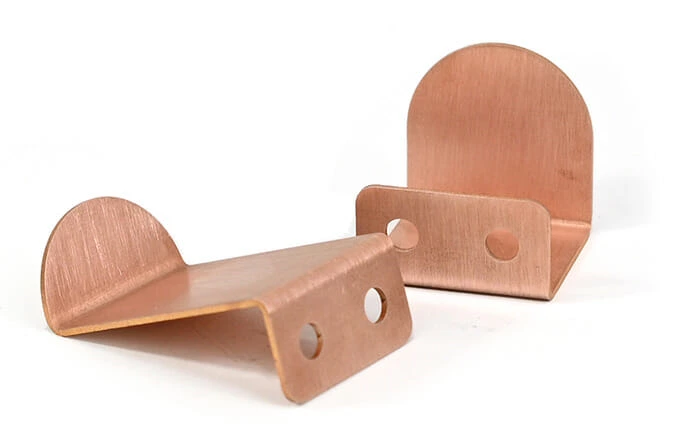
Copper size and thickness options

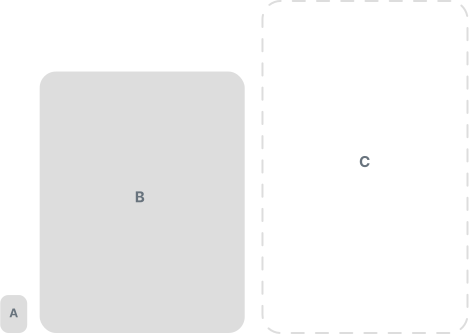
Cut Sizes

  • A..25" x .375"min Instant Pricing
  • B.30" x 44"max Instant Pricing
  • C.34" x 56"max Custom Quote
Thicknesses

Laser cut, +/- .005" tolerance

  • .032" 0.8mm
  • .040" 1.02mm
  • .063" 1.60mm
  • .125" 3.18mm
  • .187" 4.75mm
  • .250" 6.35mm

Copper material details and specifications

.032"0.8mm Copper

Material Details & Specifications

C110 COPPER .032" GENERAL DETAILS
Advertised Thickness 0.032"
Gauge 18
Thickness tolerance positive 0.004"
Thickness tolerance negative 0.004"
Top/Bottom finish Identical both sides
Sourced from USA/Global
LASER CUTTING SPECIFICATIONS
Cutting process Fiber laser
Cut tolerance +/- 0.005"
Flatness tolerance before cutting +/-0.030 per foot
Min part size .25″ x .375″
Max part size 44″ x 30″
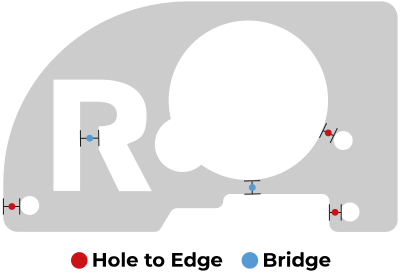
Min hole size .016″
Min bridge size .020″
Min hole to edge distance .020″
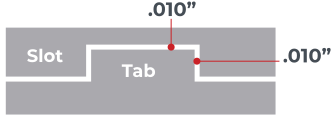
Tab and slot tolerance .010"
BENDING SPECIFICATIONS
Min bend part size .375" x 1.5"
Max bending flat part size 44" x 30"
Max bend length 44"
Min flange length (before bend/Flat Pattern) 90° or less (obtuse) 0.255"
Min flange length (after bend) 90° or less (obtuse) 0.296"
Minimum Length Center of bend line 91-130* (Acute) 0.332"
Die width 0.472"
Effective bend radius @ 90° 0.052"
Max bend angle 130°
Bend angle tolerance (bend length up to 24″) +/- 1 degree
Bend angle tolerance (bend length over 24″) +/- 2 degrees
Bend deduction @ 90° 0.081"
K Factor 0.34
Bend relief depth 0.112"
Minimum joggle. Bend line to bend line @90° max flange 0.299"
Maximum joggle. Bend line to bend line @90° max flange 3.750"
PLATING SPECIFICATIONS
Min Plating Part Size 1″ x 3″
Max Plating Part Size 23″ x 23″
C110 COPEER PROPERTIES
Material Composition Copper (Cu): 99.9 – 100 Residuals: 0 – 0.1
Density 560 lb/ft^3
Heat treatments process H00-H01 half hard
ASTM B-152
Tensile Strength (Ultimate) 43 ksi
Tensile Strength (Yield) 40 ksi
Shear Strength 12 ksi
Shear Modulus 17 ksi
Fatigue Strength 7-10 ksi
Brinell Hardness 35
Elongation at Break 13%
Elastic Modulus 16-18 ksi
Poisson’s Ratio .33
Thermal Conductivity 223 BTU/h-ft °F
Melting Point 1984 °F
Magnetic No
Does it Rust No

.040"1.02mm Copper

Material Details & Specifications

C110 COPPER .040" GENERAL DETAILS
Advertised Thickness 0.040"
Gauge 18
Thickness tolerance positive 0.008"
Thickness tolerance negative 0.002"
Top/Bottom finish Identical both sides
Sourced from USA/Global
LASER CUTTING SPECIFICATIONS
Cutting process Fiber laser
Cut tolerance +/- 0.005"
Flatness tolerance before cutting +/-0.030 per foot
Min part size .25″ x .375″
Max part size 44″ x 30″
Min hole size .016″
Min bridge size .020″
Min hole to edge distance .020″
Tab and slot tolerance .010"
BENDING SPECIFICATIONS
Min bend part size .375" x 1.5"
Max bending flat part size 44" x 30"
Max bend length 44"
Min flange length (before bend/Flat Pattern) 90° or less (obtuse) 0.255"
Min flange length (after bend) 90° or less (obtuse) 0.296"
Minimum Length Center of bend line 91-130* (Acute) 0.332"
Die width 0.472"
Effective bend radius @ 90° 0.052"
Max bend angle 130°
Bend angle tolerance (bend length up to 24″) +/- 1 degree
Bend angle tolerance (bend length over 24″) +/- 2 degrees
Bend deduction @ 90° 0.081"
K Factor 0.34
Bend relief depth 0.112"
Minimum joggle. Bend line to bend line @90° max flange 0.299"
Maximum joggle. Bend line to bend line @90° max flange 3.750"
PLATING SPECIFICATIONS
Min Plating Part Size 1″ x 3″
Max Plating Part Size 23″ x 23″
C110 COPEER PROPERTIES
Material Composition Copper (Cu): 99.9 – 100 Residuals: 0 – 0.1
Density 560 lb/ft^3
Heat treatments process H00-H01 half hard
ASTM B-152
Tensile Strength (Ultimate) 43 ksi
Tensile Strength (Yield) 40 ksi
Shear Strength 12 ksi
Shear Modulus 17 ksi
Fatigue Strength 7-10 ksi
Brinell Hardness 35
Elongation at Break 13%
Elastic Modulus 16-18 ksi
Poisson’s Ratio .33
Thermal Conductivity 223 BTU/h-ft °F
Melting Point 1984 °F
Magnetic No
Does it Rust No

.063"1.60mm Copper

Material Details & Specifications

C110 COPPER .063" GENERAL DETAILS
Advertised Thickness 0.063"
Gauge 16
Thickness tolerance positive 0.006"
Thickness tolerance negative 0.006"
Top/Bottom finish Identical both sides
Sourced from USA/Global
LASER CUTTING SPECIFICATIONS
Cutting process Fiber laser
Cut tolerance +/- 0.005"
Flatness tolerance before cutting +/-0.030 per foot
Min part size .25″ x .375″
Max part size 44″ x 30″
Min hole size .025″
Min bridge size .032″
Min hole to edge distance .020″
Tab and slot tolerance .010"
BENDING SPECIFICATIONS
Min bend part size .375" x 1.5"
Max bending flat part size 44" x 30"
Max bend length 44"
Min flange length (before bend/Flat Pattern) 90° or less (obtuse) 0.255"
Min flange length (after bend) 90° or less (obtuse) 0.305"
Minimum Length Center of bend line 91-130* (Acute) 0.332"
Die width 0.472"
Effective bend radius @ 90° 0.024"
Max bend angle 130°
Bend angle tolerance (bend length up to 24″) +/- 1 degree
Bend angle tolerance (bend length over 24″) +/- 2 degrees
Bend deduction @ 90° 0.099"
K Factor 0.36
Bend relief depth 0.107"
Minimum joggle. Bend line to bend line @90° max flange 0.324"
Maximum joggle. Bend line to bend line @90° max flange 3.750"
DEBURRING SPECIFICATIONS
Min deburring part size 1" x 3"
Max deburring part size 36″ x 46″
PLATING SPECIFICATIONS
Min Plating Part Size 1″ x 3″
Max Plating Part Size 23″ x 23″
TAPPING SPECIFICATIONS
Largest Tap M6 x 1.0
Smallest Tap M2 x 0.4
Min Flat Part Size Tapping 0.949" x 1.5"
Max Flat Part Size Tapping 36" x 46"
Tapping Min Hole to Edge 0.020"
Tapping Min Hole Center to Material Edge Tap hole size/2 +0.020"
C110 COPPER PROPERTIES
Material Composition Copper (Cu): 99.9 – 100 Residuals: 0 – 0.1
Density 560 lb/ft^3
Heat treatments process H00-H01 half hard
ASTM B-152
Tensile Strength (Ultimate) 43 ksi
Tensile Strength (Yield) 40 ksi
Shear Strength 12 ksi
Shear Modulus 17 ksi
Fatigue Strength 7-10 ksi
Brinell Hardness 35
Elongation at Break 13%
Elastic Modulus 16-18 ksi
Poisson’s Ratio .33
Thermal Conductivity 223 BTU/h-ft °F
Melting Point 1984 °F
Magnetic No
Does it Rust No

.125"3.18mm Copper

Material Details & Specifications

C110 COPPER .125" GENERAL DETAILS
Advertised Thickness 0.125"
Gauge 11
Thickness tolerance positive 0.008"
Thickness tolerance negative 0.008"
Top/Bottom finish Identical both sides
Sourced from USA/Global
LASER CUTTING SPECIFICATIONS
Cutting process Fiber laser
Cut tolerance +/- 0.005"
Flatness tolerance before cutting +/-0.030 per foot
Min part size .25″ x .375″
Max part size 44″ x 30″
Min hole size .040″
Min bridge size .037″
Min hole to edge distance .038″
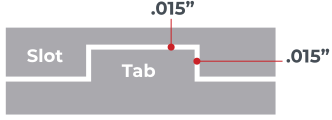
Tab and slot tolerance .015"
BENDING SPECIFICATIONS
Min bend part size .375" x 1.5"
Max bending flat part size 44" x 30"
Max bend length 44"
Min flange length (before bend/Flat Pattern) 90° or less (obtuse) 0.368"
Min flange length (after bend) 90° or less (obtuse) 0.471"
Minimum Length Center of bend line 91-130* (Acute) 0.478"
Die width 0.630"
Effective bend radius @ 90° 0.050"
Max bend angle 130°
Bend angle tolerance (bend length up to 24″) +/- 1 degree
Bend angle tolerance (bend length over 24″) +/- 2 degrees
Bend deduction @ 90° 0.205"
K Factor 0.34
Bend relief depth 0.195"
Minimum joggle. Bend line to bend line @90° max flange 0.506"
Maximum joggle. Bend line to bend line @90° max flange 3.750"
DEBURRING SPECIFICATIONS
Min deburring part size 1" x 3"
Max deburring part size 36″ x 46″
PLATING SPECIFICATIONS
Min Plating Part Size 1″ x 3″
Max Plating Part Size 23″ x 23″
TAPPING SPECIFICATIONS
Largest Tap M10 x 1.5
Smallest Tap M2 x 0.4
Min Flat Part Size Tapping 0.949" x 1.5"
Max Flat Part Size Tapping 36" x 46"
Tapping Min Hole to Edge 0.038"
Tapping Min Hole Center to Material Edge Tap hole size/2 +0.038"
TUMBLE SPECIFICATIONS
Min Part Size Tumbling 0.5″ x 1.5″
Max Part Size Tumbling 4″ x 7″
C110 COPPER PROPERTIES
Material Composition Copper (Cu): 99.9 – 100 Residuals: 0 – 0.1
Density 560 lb/ft^3
Heat treatments process H00-H01 half hard
ASTM B-152
Tensile Strength (Ultimate) 43 ksi
Tensile Strength (Yield) 40 ksi
Shear Strength 12 ksi
Shear Modulus 17 ksi
Fatigue Strength 7-10 ksi
Brinell Hardness 35
Elongation at Break 13%
Elastic Modulus 16-18 ksi
Poisson’s Ratio .33
Thermal Conductivity 223 BTU/h-ft °F
Melting Point 1984 °F
Magnetic No
Does it Rust No

.187"4.75mm Copper

Material Details & Specifications

C110 COPPER .187" GENERAL DETAILS
Advertised Thickness 0.187"
Gauge N/A
Thickness tolerance positive 0.010"
Thickness tolerance negative 0.010"
Top/Bottom finish Identical both sides
Sourced from USA/Global
LASER CUTTING SPECIFICATIONS
Cutting process Fiber laser
Cut tolerance +/- 0.005"
Flatness tolerance before cutting +/-0.030 per foot
Min part size .25″ x .375″
Max part size 44″ x 30″
Min hole size .060″
Min bridge size .065″
Min hole to edge distance .056″
Tab and slot tolerance .015"
BENDING SPECIFICATIONS
Min bend part size .375" x 1.5"
Max bending flat part size 44" x 30"
Max bend length 44"
Min flange length (before bend/Flat Pattern) 90° or less (obtuse) 0.620"
Min flange length (after bend) 90° or less (obtuse) 0.780"
Minimum Length Center of bend line 91-130* (Acute) N/A
Die width 0.984"
Effective bend radius @ 90° 0.118"
Max bend angle 90°
Bend angle tolerance (bend length up to 24″) +/- 1 degree
Bend angle tolerance (bend length over 24″) +/- 2 degrees
Bend deduction @ 90° 0.320"
K Factor 0.36
Bend relief depth 0.305"
Minimum joggle. Bend line to bend line @90° max flange 0.826"
Maximum joggle. Bend line to bend line @90° max flange 3.750"
DEBURRING SPECIFICATIONS
Min deburring part size 1" x 3"
Max deburring part size 36″ x 46″
PLATING SPECIFICATIONS
Min Plating Part Size 1″ x 3″
Max Plating Part Size 23″ x 23″
TAPPING SPECIFICATIONS
Largest Tap 1/2-20
Smallest Tap M2 x 0.4
Min Flat Part Size Tapping 0.949" x 1.5"
Max Flat Part Size Tapping 36" x 46"
Tapping Min Hole to Edge 0.056"
Tapping Min Hole Center to Material Edge Tap hole size/2 +0.056"
TUMBLE SPECIFICATIONS
Min Part Size Tumbling 0.5″ x 1.5″
Max Part Size Tumbling 4″ x 7″
C110 COPPER PROPERTIES
Material Composition Copper (Cu): 99.9 – 100 Residuals: 0 – 0.1
Density 560 lb/ft^3
Heat treatments process H00-H01 half hard
ASTM B-152
Tensile Strength (Ultimate) 43 ksi
Tensile Strength (Yield) 40 ksi
Shear Strength 12 ksi
Shear Modulus 17 ksi
Fatigue Strength 7-10 ksi
Brinell Hardness 35
Elongation at Break 13%
Elastic Modulus 16-18 ksi
Poisson’s Ratio .33
Thermal Conductivity 223 BTU/h-ft °F
Melting Point 1984 °F
Magnetic No
Does it Rust No

.250"6.35mm Copper

Material Details & Specifications

C110 COPPER .250" GENERAL DETAILS
Advertised Thickness 0.250"
Gauge N/A
Thickness tolerance positive 0.012"
Thickness tolerance negative 0.012"
Top/Bottom finish Identical both sides
Sourced from USA/Global
LASER CUTTING SPECIFICATIONS
Cutting process Fiber laser
Cut tolerance +/- 0.005"
Flatness tolerance before cutting +/-0.030 per foot
Min part size .25″ x .375″
Max part size 44″ x 30″
Min hole size .089″
Min bridge size .080″
Min hole to edge distance .075″
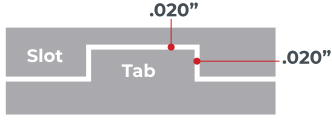
Tab and slot tolerance .020"
BENDING SPECIFICATIONS
Min bend part size .375" x 1.5"
Max bending flat part size 44" x 30"
Max bend length 44"
Min flange length (before bend/Flat Pattern) 90° or less (obtuse) 1.150"
Min flange length (after bend) 90° or less (obtuse) 1.365"
Minimum Length Center of bend line 91-130* (Acute) N/A
Die width 1.575"
Effective bend radius @ 90° 0.140"
Max bend angle 90°
Bend angle tolerance (bend length up to 24″) +/- 1 degree
Bend angle tolerance (bend length over 24″) +/- 2 degrees
Bend deduction @ 90° 0.430"
K Factor 0.33
Bend relief depth 0.405"
Minimum joggle. Bend line to bend line @90° max flange 1.425"
Maximum joggle. Bend line to bend line @90° max flange 3.750"
DEBURRING SPECIFICATIONS
Min deburring part size 1" x 3"
Max deburring part size 36″ x 46″
PLATING SPECIFICATIONS
Min Plating Part Size 1″ x 3″
Max Plating Part Size 23″ x 23″
TAPPING SPECIFICATIONS
Largest Tap 1/2-20
Smallest Tap 4-40
Min Flat Part Size Tapping 0.949" x 1.5"
Max Flat Part Size Tapping 36" x 46"
Tapping Min Hole to Edge 0.075"
Tapping Min Hole Center to Material Edge Tap hole size/2 +0.075"
TUMBLE SPECIFICATIONS
Min Part Size Tumbling 0.5″ x 1.5″
Max Part Size Tumbling 4″ x 7″
C110 COPPER PROPERTIES
Material Composition Copper (Cu): 99.9 – 100 Residuals: 0 – 0.1
Density 560 lb/ft^3
Heat treatments process H00-H01 half hard
ASTM B-152
Tensile Strength (Ultimate) 43 ksi
Tensile Strength (Yield) 40 ksi
Shear Strength 12 ksi
Shear Modulus 17 ksi
Fatigue Strength 7-10 ksi
Brinell Hardness 35
Elongation at Break 13%
Elastic Modulus 16-18 ksi
Poisson’s Ratio .33
Thermal Conductivity 223 BTU/h-ft °F
Melting Point 1984 °F
Magnetic No
Does it Rust No
 What is Copper?

What is Copper?

Our C110 half-hard copper is classified as electrolytic copper, which basically means it’s an extremely high purity (greater than 99% copper, ours is 99.9%). For your projects, this means that the material’s electrical properties won’t be hampered by any erroneous leftover elements. You’re getting one of the purest grades available.

What can you make with Copper parts?

Copper, only surpassed by silver in its electrical properties, is perfect for hospital settings due to its antimicrobial nature. In diagnostic equipment, you’ll find this material assisting in transmitting signals for examination and providing the necessary structure in small, vital implants.

Send us your design and we’ll help you manufacture the highest-quality busbars, heat sinks, connectors and more.

  • Motor parts
  • Industrial machinery
  • Electronic components
  • Wiring
  • Roofing
  • Solar kits
  • RV conversion kits
  • Plumbing
  • And so much more!

Copper FAQs

Choose from six thicknesses including .032″ (0.8mm), .040″(1.02mm), .063″(1.60mm), .125″(3.18mm), .187″(4.75mm), and .250″(6.35mm)

Copper is available at SendCutSend with a range of thicknesses and part sizes. Instant quotes are possible for dimensions between .25″ x .375″ and 30″ x 44″.

You can add the following services to your Copper parts:
Bending, Deburring, Plating, Tapping, and Tumbling

Start your first Metal Manufacturing project today!

Upload your CAD design, or try one of our customizable part templates to get instant pricing on your custom laser cut parts. All delivered to your door in a matter of days.

Waterjet

Upload a CAD file

We accept .ai, .dxf, .dwg, .eps, .stp, and .step

Start Your Quote

Copper sheet metal properties, fabrication tips, and laser cutting guide

Copper is one of the most recognizable and useful metals in fabrication, prized for its exceptional electrical and thermal conductivity, natural corrosion resistance, and timeless appearance. Whether you’re designing electrical components, decorative parts, or precision mechanical features, copper brings performance and style to the table.  Below, we cover the most common questions about copper sheet, its fabrication behavior, and how to get the best results when designing for SendCutSend’s laser cutting services.

Key takeaways for copper sheet

  • Excellent electrical and thermal conductivity: Ideal for electrical, electronic, and heat-transfer applications.
  • Naturally corrosion resistant: Forms a stable patina over time that protects against further oxidation.
  • Laser cut precision: Clean, burr-free cuts with ±.005″ tolerance.
  • Highly formable and ductile: Perfect for bending, stamping, and shaping without cracking.
  • Supports multiple finishing services: SendCutSend offers bending, deburring, plating, tapping, and tumbling for completed copper parts.

What is copper sheet metal?

Copper is a pure, non-ferrous metal known for its conductivity, corrosion resistance, and easy formability. It’s a mainstay across electrical, decorative, and architectural projects due to its distinct reddish-gold color and resistance to environmental degradation. Copper’s malleability makes it one of the easiest metals to bend and shape, even in thin gauges.

What are the physical and mechanical properties of copper?

Copper is relatively soft yet strong enough for structural use in many low-stress applications. Typical properties:

  • Density: 8.96 g/cm³ (0.323 lb/in³)
  • Tensile strength: ~32–55 ksi (220–380 MPa) depending on temper
  • Yield strength: ~10–33 ksi (70–230 MPa)
  • Thermal conductivity: 401 W/m·K (among the highest of all metals)
  • Electrical conductivity: ~100% IACS (benchmark for conductivity)
  • Melting point: 1,984°F (1,085°C)

This balance of conductivity, ductility, and strength makes copper invaluable for both industrial and artistic applications.

What are the common applications for copper?

Copper’s versatility spans from high-performance electrical systems to architectural finishes. Common applications include:

  • Electrical bus bars and grounding straps
  • Decorative signage and wall art
  • Heat sinks and thermal plates
  • RF shielding and electronic housings
  • Architectural panels, nameplates, and accents

For other high-conductivity metals, see our Material Catalog to compare copper with brass or aluminum.

How does copper compare to brass or aluminum?

Copper has higher conductivity and a richer natural color, but is softer and heavier than brass or aluminum.

  • Brass: Copper is harder and more corrosion-resistant than brass in humid environments, but lower in conductivity.
  • Aluminum: Copper is lighter and less expensive, but only ~60% as conductive.
  • Copper: The premium choice for electrical and thermal performance, as well as visual appeal.

If your design emphasizes conductivity or aesthetic finish, copper is usually the right choice.

How does copper perform during laser cutting?

Copper laser cuts cleanly with SendCutSend’s high-powered fiber lasers, achieving ±.005″ tolerances and smooth edges.

  • Edge quality: Bright, clean edges with minimal burrs.
  • Heat-affected zone: Very small due to the laser’s high precision and copper’s thermal conductivity.
  • Cutting behavior: Copper reflects CO₂ laser light, but modern fiber lasers handle it efficiently with no cutting degradation.

For best results, avoid ultra-small features below our minimum feature size guidelines.

What tolerances and surface finish should be expected with copper?

Laser-cut copper at SendCutSend achieves ±.005″ cutting tolerance with a natural mill finish.

  • Surface finish: Smooth and reflective with a bright copper tone.
  • Oxidation: Light discoloration may occur near the cut edges due to heat, which can be polished off or allowed to patina naturally.
  • Post-processing: Tumbling and deburring are available to clean and smooth surfaces; plating can enhance corrosion resistance and appearance.

For more details, see the Copper Material Specifications.

Can copper be bent or formed?

Yes, copper is one of the most formable metals available.

  • Excellent ductility allows tight-radius bends without cracking.
  • Softness makes it easy to cold form by hand or machine.
  • Over-bending compensation is minimal due to low springback.

SendCutSend offers bending on Copper. To design your copper parts for accurate bends, review our Bending Guidelines.

Can copper be tapped or drilled?

Yes, copper taps and drills very cleanly when designed with proper hole sizing and thread depth.

  • Use standard thread sizes and ensure at least 60% thread engagement for durability.
  • Copper’s ductility means threads form easily without galling.
  • At SendCutSend, tapping services are available directly during production.

See our Tapping Guidelines for thread callouts and hole sizing recommendations for tapping your Copper parts. 

What finishing options are available for copper?

Copper can be finished for appearance, conductivity, or protection. At SendCutSend, we offer several post-processing options:

  • Deburring and tumbling: Smooth edges and remove any fine burrs.
  • Plating: Nickel or tin plating can reduce oxidation and improve durability.
  • Powder Coating: Adds a protective and aesthetic layer to your parts and improves durability.

See a list of all SendCutSend finishing services for further details and service guidelines.

How does copper behave over time?

Copper forms a natural oxide layer, often called a patina, that protects it from corrosion.

  • Indoors: Copper remains bright with minimal color change.
  • Outdoors: A rich brown or green patina develops over time.
  • Performance: The patina actually improves corrosion resistance without affecting conductivity.

If you prefer to maintain a bright finish, a clear lacquer or plating can preserve its color.

Design tips for working with copper

Keep copper’s softness and conductivity in mind when designing for laser cutting and fabrication.

  • Avoid ultra-thin webs or unsupported tabs that may distort.
  • Add generous fillets in tight corners to reduce stress.
  • Use standard hole clearances for fasteners or tapped threads.
  • Plan for post-processing if surface appearance is critical.

For additional fabrication insights, visit our Design Guidelines.

Design takeaways for laser cut copper 

Copper brings unbeatable conductivity, corrosion resistance, and visual warmth to your projects. With SendCutSend’s laser cutting accuracy (±.005″) and available bending, plating, deburring, tapping, and tumbling services, your copper parts can move from concept to finished product with speed and precision. Explore our Material Catalog to see how copper stacks up against brass, aluminum, and stainless steel.

KH-TAT Electronic

Tell Us Your Requirements

For more information about KH-TAT Electronic CNC Tool’s cutting tool solutions, including standard and custom carbide drills, end mills, coatings, and machining support, please feel free to contact our team.
  • Email Brian@wjwanjia.com
  • WhatsApp +86 18967883827
  • Address No. 26, Fenghuang Second Street, Yongchuan District, Chongqing (within Fenghuang Lake Industrial Park, Yongchuan Industrial Park, Chongqing)

    Room 2008, North Building, Yinzhou Chamber of Commerce Building, Yinzhou District, Ningbo City, Zhejiang Province

    Nong Bon Daeng 13, Nong Bon Daeng, Ban Bang Xian, Chon buri 20170, Thailand

This site uses cookies

We use cookies to collect information about how you use this site. We use this information to make the website work as well as possible and improve our services.more details