
| ABS .125" General Details | |
|---|---|
| Advertised Thickness | 0.125" |
| Gauge | N/A |
| Thickness tolerance positive | 0.007" |
| Thickness tolerance negative | 0.006" |
| Top/Bottom finish | Haircell top side, smooth bottom |
| Sourced from | USA |
| CNC ROUTER CUTTING SPECIFICATIONS | |
| Cutting process | CNC Router |
| Cut tolerance +/- | 0.005" |
| Flatness tolerance before cutting | +/-0.030 per foot |
| Min part size | 1.00″ x 2.00″ |
| Max part size | 44″ x 44″ |
| Min hole size | .125″ |
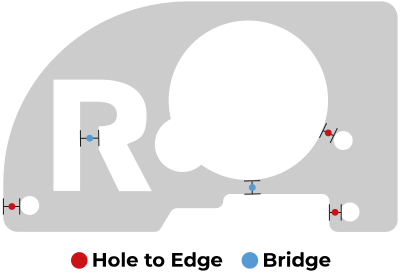
| Min bridge size | .125″ |
| Min hole to edge distance | .038″ |
 |
|
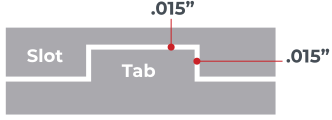
| Tab and slot tolerance | .015" |
 |
|
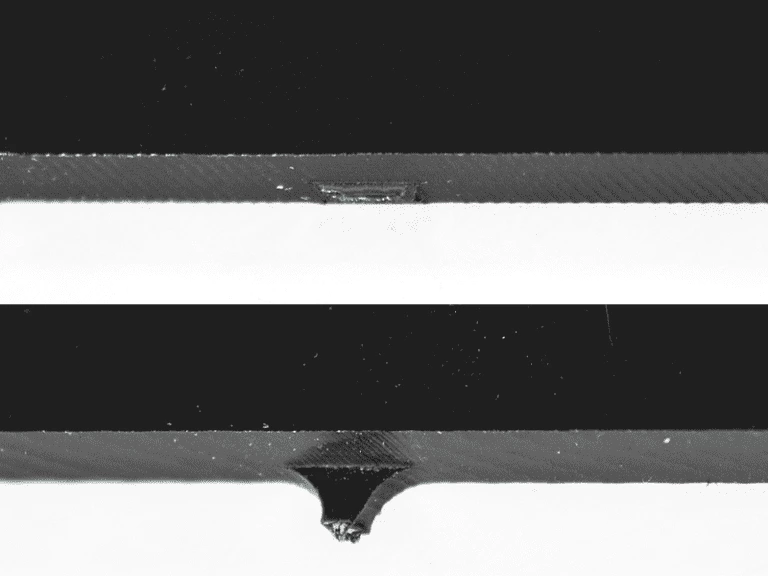
| COUNTERSINK SPECIFICATIONS | |
| Min countersink part size | 1" x 4" |
| Max countersink part size | 14″ x 46″ |
| Countersink Min Minor | .130" |
| Countersink Max Major | .472″ |
| Countersink Min Hole Center to Material Edge | .246" |
| TAPPING SPECIFICATIONS | |
| Largest Tap | M10 x 1.5 |
| Smallest Tap | M4 x 0.7 |
| Min Flat Part Size Tapping | 0.949" x 1.5" |
| Max Flat Part Size Tapping | 36" x 46" |
| Tapping Min Hole to Edge | 0.038" |
| Tapping Min Hole Center to Material Edge | Tap hole size/2 +0.038" |
| ABS PROPERTIES | |
| Material Composition | Acrylonitrile Butadiene Styrene |
| Density | 65.664 lb/ft^3 |
| Heat treatments process | N/A |
| ASTM | D4673 |
| Tensile Strength (Ultimate) | 4.5 ksi |
| Tensile Strength (Yield) | 3.5 ksi |
| Shear Strength | 2 ksi |
| Shear Modulus | 75 ksi |
| Fatigue Strength | 2 ksi |
| Izod Impact Strength | 6.3 ft-lbs/in |
| Coefficient of Friction | 0.19 – 0.21 |
| Rockwell | R 90 - R100 |
| Elongation at Break | 25% |
| Elastic Modulus | 340 ksi |
| Poisson’s Ratio | .35 |
| Thermal Conductivity | 0.22 BTU/h-ft °F |
| Vicat Softening Temp | 224 °F |
| Continuous Service Temp (Operating) | 150 °F |
| Melting Point | 390 °F |
| Magnetic | No |
| Does it Rust | No |
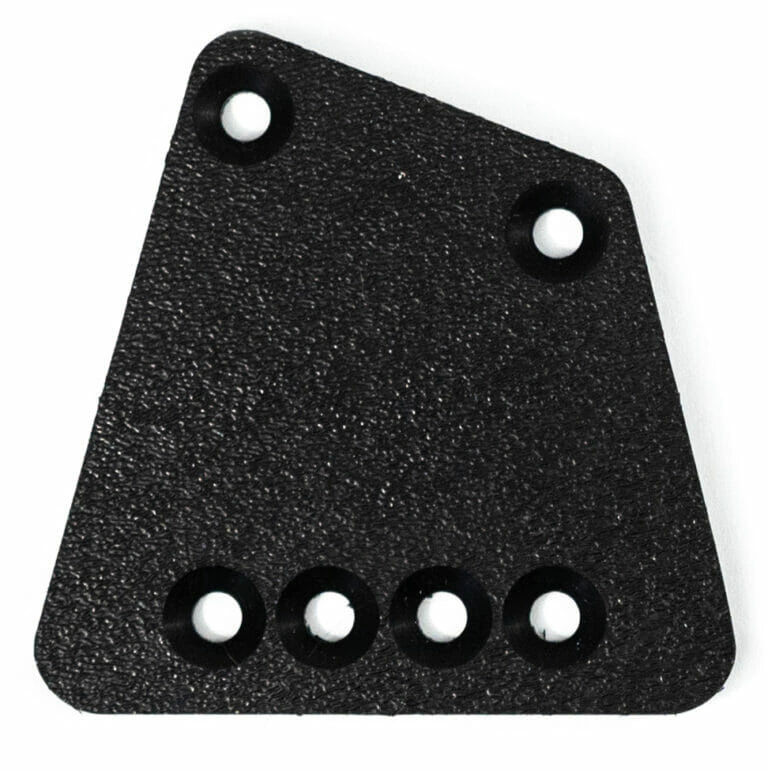
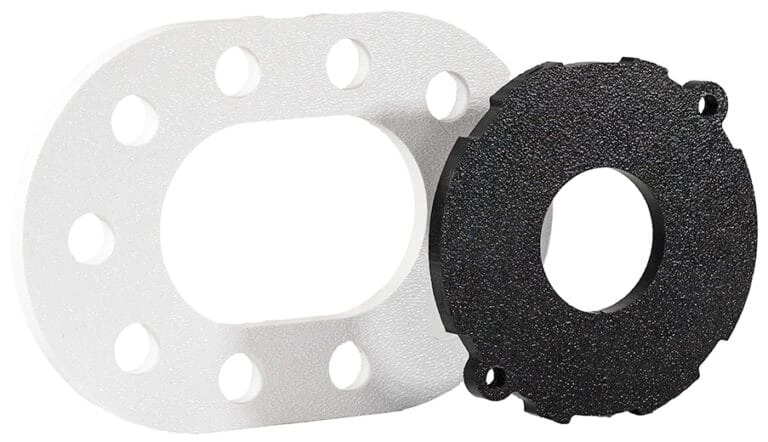

ABS plastic: Lightweight durability for enclosures, panels, and functional prototypes
ABS (Acrylonitrile Butadiene Styrene) is one of the most widely used engineering plastics thanks to its toughness, impact resistance, and excellent machinability. It’s strong enough for functional mechanical parts yet forgiving enough for fast prototyping and iterative design. Fabricators, engineers, and makers choose ABS when they need a material that cuts cleanly, withstands impact, and holds threaded fasteners — without cracking or chipping. At SendCutSend, we CNC route USA-sourced ABS plastic in .125”, .187”, and .234” thicknesses to ±.005” tolerance, making it ideal for custom enclosures, shop fixtures, panels, and small engineering components.
What are the key things to know about ABS plastic?
- Tough and impact resistant: durable under mechanical load and vibration.
- Easy to machine: drills, mills, and CNC routes cleanly without cracking.
- Lightweight and rigid: maintains shape without excessive flex.
- Moderately heat resistant: suitable for indoor environments only.
- Chemical tolerant: resists oils, greases, and many shop chemicals.
These traits make ABS one of the most practical plastics for real-world mechanical parts and functional prototypes.
Why do fabricators choose ABS plastic for their projects?
Fabricators choose ABS because it strikes a rare balance between rigidity, durability, and machinability. Unlike acrylic, it won’t crack under stress. Unlike HDPE, it holds its shape and resists flexing. Unlike Delrin, it remains affordable and easy to route in large panels. Common reasons people choose ABS:
- It’s forgiving during machining and tapping.
- It’s durable enough for machine guards, robot housings, and internal mechanical parts.
- It offers a clean, professional appearance without polishing or painting.
- It withstands impact, vibration, and day-to-day use.
- It’s affordable for both prototypes and production parts.
ABS is function-first plastic. It’s ideal for parts that will actually be used, handled, or exposed to stress.
What are the advantages of using ABS plastic?
- Exceptional machinability ABS is one of the easiest plastics to work with using CNC routing, drilling, and tapping. It doesn’t chip or crack and can maintain tight tolerances.
- Toughness and impact resistance ABS absorbs energy without shattering, making it great for:
- Machine guards
- Enclosures
- Fixtures
- Prototyping
- Internal housings
- Lightweight rigidity It’s stiff enough for enclosures and fixtures but lighter than aluminum or phenolic laminates.
- Chemical and wear resistance Resistant to oils, greases, and cleaning chemicals. It’s perfect for factory, workshop, and automotive environments.
- Professional appearance ABS’s matte black surface has a finished, production-ready look straight off the CNC router.
What are the limitations or drawbacks of ABS plastic?
- Not UV-stable long term Outdoor sun exposure can cause fading, brittleness, or warping. For outdoor-rated materials, consider:
- Low high-temperature resistance ABS softens around 175°F (80°C). It should not be used near heat sources or in high-friction applications where heat buildup is possible.
- Visible machined edges Routed edges have a matte texture and cannot be polished to a glass-clear finish like acrylic.
- Can flex if too thin Long, thin geometries or unsupported walls can bend more than expected. Using thicker gauges solves this.
- Not food-safe ABS should not be used in kitchen equipment or food-contact environments.
How does ABS plastic behave during CNC routing?
ABS routes extremely well. The material remains stable under tool pressure and evacuates chips cleanly, resulting in sharp edges and accurate geometry. Key routing behaviors:
- Cuts smoothly with no chipping
- Does not melt or smear under normal feeds/speeds
- Maintains dimensional stability across large panels
- Produces consistent edge texture
- Allows tight curves and internal pockets
SendCutSend routes ABS to ±.005” tolerance, ensuring precise fitment for mechanical parts and enclosures.
How should I design parts for ABS plastic?
ABS is forgiving, but good design choices ensure reliable, long-lasting parts.
Best practices for parts made out for ABS plastic:
- Keep hole diameters larger than the material thickness
- Add fillets to internal corners to reduce stress concentrations
- Avoid narrow “fingers” or long unsupported arms in .125” ABS
- Use standoffs or washers when fastening
- Avoid extremely tight tolerance fits — ABS has slight flex and compliance
- Use threaded inserts or machine screws for assembly
- Consider ribbing or thicker walls for added rigidity
More guidance is available in the SendCutSend design guidelines.
Where is ABS plastic most commonly used?
Popular applications include:
- Electronics housings and enclosures
- Robotics covers and automation components
- Machine guards and shop equipment
- Jigs, fixtures, and prototyping tools
- Automotive interior panels and trim pieces
- Consumer product casings
- Props, costume parts, and lightweight structural elements
ABS is widely used in industry because it’s dependable, easy to machine, and strong enough for everyday functional components.
Are SendCutSend ABS plastic parts made in the USA?
SendCutSend sources ABS plastic from domestic U.S. suppliers, ensuring stable supply, consistent quality, and reliable performance. All fabrication, inspection, and shipping of ABS plastic parts through SendCutSend take place in our three U.S. manufacturing facilities:
- Reno, Nevada
- Paris, Kentucky
- Arlington, Texas
This U.S-based workflow allows us to maintain tight tolerances, fast lead times, and dependable material availability for every order.
When should I use ABS plastic for my project?
Choose ABS plastic when you need a tough, machinable, lightweight engineering plastic that’s strong enough for real mechanical use. It’s ideal for enclosures, fixtures, tooling, panels, and functional prototypes that need durability without brittleness. You should consider ABS when your part requires:
- Good impact resistance
- Clean machining behavior
- A professional matte appearance
- Structural strength without metal weight
- Reliable performance in shops, labs, and indoor industrial environments
At SendCutSend, we CNC route USA-sourced ABS plastic to ±.005” precision with 2–4 day lead times, giving makers, engineers, and manufacturers fast access to one of the most versatile plastics in fabrication.