Delrin (acetal): Strong, low-friction plastic for gears, bushings, and high-performance parts
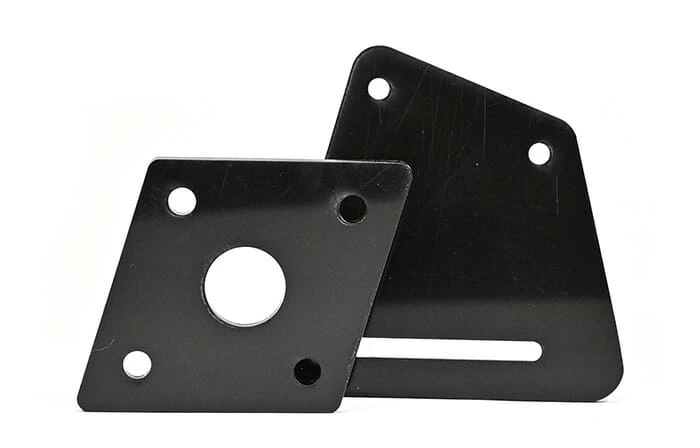
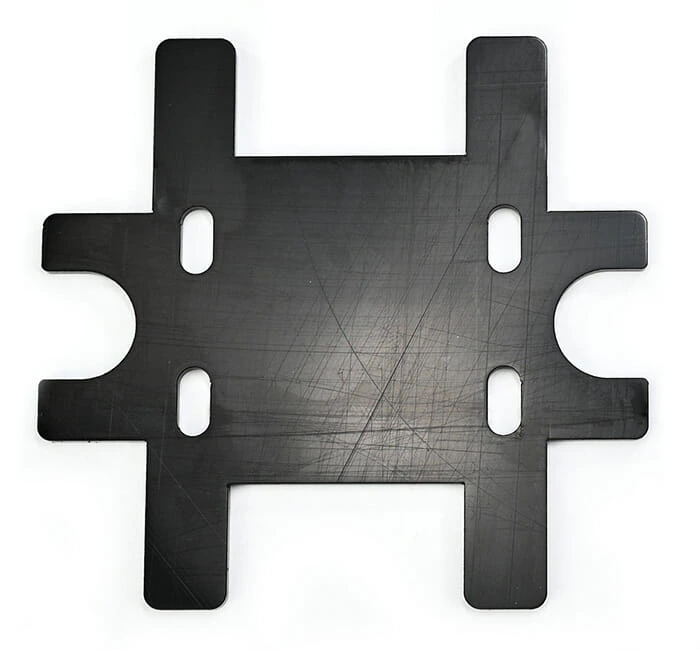
Delrin, also known as acetal homopolymer or POM-H, is one of the strongest, stiffest engineering plastics available. It excels in applications where low friction, dimensional stability, and wear resistance matter more than flexibility or impact absorption. Its mechanical behavior is closer to light metal than to traditional plastics, which is why Delrin is used heavily in robotics, aerospace, automotive, and precision mechanical assemblies. At SendCutSend, we route or laser cut USA-sourced Delrin in .125” and .270” thicknesses, depending on material thickness and part geometry, with available countersinking and tapping services. Delrin is ideal for components that need strength, durability, and tight tolerances without the weight or corrosion of metal.
What are the key things to know about Delrin?
- Extremely stiff and strong: Delrin is one of the most rigid engineering plastics.
- Low friction and wear-resistant: Delrin is ideal for sliding, rotating, and bearing parts.
- Dimensionally stable: Delrin maintains shape and size better than most plastics.
- Excellent machinability: Delrin drills, taps, and routs like a soft metal.
- Moisture and chemical resistant: Delrin is suitable for industrial and mechanical environments.
These characteristics make Delrin one of the top choices for mechanical components made from plastic.
Why do fabricators choose Delrin for mechanical parts?
Fabricators choose Delrin because it provides metal-like performance without metal-like weight or corrosion. Delrin’s stiffness and low-friction surface make it ideal for precision parts that need to glide, rotate, or withstand repetitive movement. Common reasons fabricators choose Delrin:
- It performs consistently under load.
- It handles sliding friction better than almost any standard plastic.
- It doesn’t absorb moisture or warp in changing climates.
- It can be drilled, tapped, and machined with tight tolerances.
- It holds threads extremely well for a plastic.
- It’s forgiving during machining and resists chipping.
Delrin shines where ABS is too soft, acrylic is too brittle, and metal is overkill.
What are the advantages of using Delrin?
1. Excellent strength and rigidity
Delrin is significantly stiffer than ABS or HDPE. It maintains shape under load, making it ideal for gears, levers, cams, machine components, and structural plastic parts.
2. Outstanding low-friction performance
Delrin has a naturally slippery surface, similar to PTFE (Teflon), but with much greater strength. This makes it ideal for:
- Bushings
- Bearings
- Wear plates
- Sliding mechanisms
- Hinges and pivots
3. High wear and fatigue resistance
Parts under repeated cycles — rotating, impacting, sliding — last much longer in Delrin than in most plastics.
4. Excellent machinability
Delrin machines like a soft metal:
- Produces clean chips
- Allows drilled and tapped holes
- Maintains tight tolerances
- Avoids stress cracking
This is a major advantage over acrylic, which cracks, or over HDPE, which “gums up” during machining.
5. Dimensional stability
Delrin absorbs very little moisture and maintains tolerances even in environments with temperature or humidity changes.
What are the limitations or drawbacks of Delrin?
1. Not UV stable
Delrin is not recommended for long-term outdoor use. Prolonged sunlight can cause chalking, embrittlement, and surface cracking. For outdoor plastics, consider:
2. Low bonding ability
Delrin is difficult to glue, most adhesives do not bond to it. Mechanical fastening is preferred.
3. Limited high-heat resistance
While more heat-resistant than ABS, Delrin will still deform or degrade at prolonged temperatures above ~185–200°F.
4. Can creep under very high loads
Like all plastics, Delrin can deform over long periods if subjected to constant, high static load.
How does Delrin behave when laser cut or CNC routed?
SendCutSend chooses the cutting method based on material thickness and part geometry:
Laser cutting (most .125” parts)
Delrin laser cuts extremely cleanly:
- Smooth, glossy edges
- Minimal burring
- Excellent dimensional accuracy
- No cracking or chipping
- Very little discoloration
Laser cutting gives Delrin that signature polished edge engineers love.
CNC routing (required for .270”)
Thicker Delrin (.270″) CNC routes beautifully:
- Chips evacuate cleanly
- Edges are smooth and uniform
- No melting with proper feeds and speeds
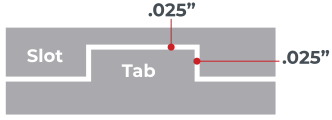
- Maintains tight geometries and slot widths
Routing also allows additional services like countersinking and tapping.
Notes on heat
Although Delrin cuts well with a laser, parts with extremely sharp internal corners or very thin features may require routing to avoid heat buildup. If your geometry is borderline, the SendCutSend quoting system will automatically choose the safest process.
How should I design Delrin parts?
Delrin is strong and machinable, but designing with intention improves part performance.
Best practices:
- Keep hole diameters greater than or equal to material thickness.
- Use generous fillets for internal corners.
- Avoid long, thin fingers or unsupported arms — choose thicker .270” stock when possible.
- Add ribs if you need stiffness without added weight.
- Use mechanical fasteners (Delrin does not glue reliably).
- Use washers when fastening near edges.
- For threaded holes, consider SendCutSend’s tapping service.
- For recessed fasteners, use SendCutSend’s countersinking service.
More guidance is available in the SendCutSend design guidelines.
What secondary services can SendCutSend provide for Delrin?
SendCutSend currently offers tapping and countersinking for Delrin.
Tapping
Delrin holds threaded holes extremely well. Tapped holes are ideal for:
- Brackets
- Small assemblies
- Robotics components
- Jigs and fixtures
- Prototyping hardware
Countersinking
Countersinks route cleanly in Delrin with crisp, smooth edges. Perfect for flush-mount screws in:
- Covers
- Panels
- Mechanical plates
- Electronics enclosures
These services provide ready-to-assemble Delrin parts straight out of the box.
Where is Delrin most commonly used?
Delrin is widely used anywhere a part needs strength, stiffness, and repeatable mechanical performance. Typical applications include:
- Gears, sprockets, and pulleys
- Bushings, bearings, and wear components
- Cams, levers, and mechanical linkages
- Robotics and automation hardware
- Consumer product components
- Instrument and machine parts
- Structural plastic elements in assemblies
- Fixtures, guides, and jigs
If a part needs to slide, rotate, or withstand mechanical load, Delrin is often one of the best plastics for the job.
Are Delrin parts from SendCutSend made in the USA?
SendCutSend sources Delrin from domestic U.S. suppliers, ensuring reliable supply, consistent sheet quality, and predictable machining behavior. All cutting, tapping, countersinking, inspection, and shipping take place in our three U.S. manufacturing facilities:
- Reno, Nevada
- Paris, Kentucky
- Arlington, Texas
This domestic workflow ensures fast turnaround times, exceptional quality control, and dependable material availability for every order.
When should I use Delrin for my project?
Choose Delrin when you need a stiff, strong, low-friction engineering plastic that performs more like a metal than a traditional polymer. It’s one of the best materials for gears, sliders, bushings, and mechanical components that must withstand repetitive movement, wear, and load. You should consider Delrin if your part requires:
- Precise machining or tapping
- Low friction and smooth sliding
- Dimensional stability
- Strong, rigid performance
- Resistance to wear and fatigue
- Lightweight alternatives to metal
At SendCutSend, we laser cut or CNC route USA-sourced Delrin with ±.005” tolerances, offering optional tapping and countersinking for ready-to-assemble components. For mechanical parts that need long service life with low friction, Delrin is one of the strongest choices available.