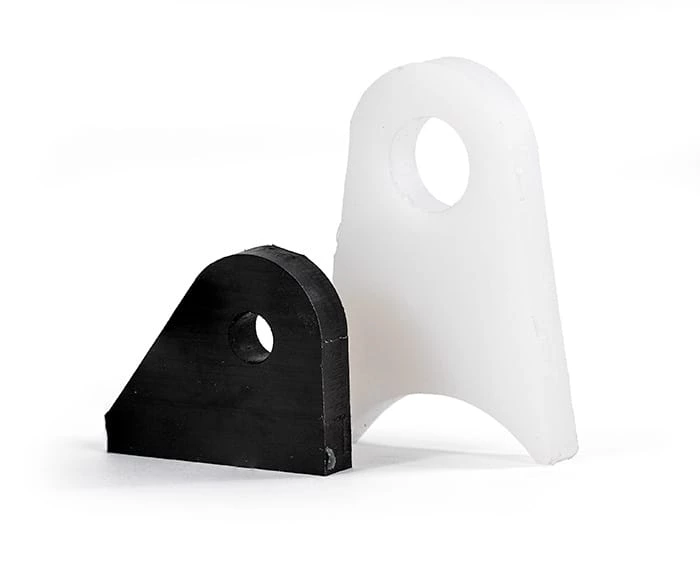
UHMW plastic: Extreme wear resistance, low friction, and durability for high-impact applications
UHMW (Ultra-High-Molecular-Weight Polyethylene) is one of the toughest and most wear-resistant plastics used in fabrication. Known for its extremely low coefficient of friction and exceptional impact strength, UHMW is often chosen for parts that must endure sliding contact, abrasive wear, heavy load impacts, and repetitive mechanical abuse. Unlike rigid engineering plastics like Delrin, UHMW behaves more like a durable, slick, self-lubricating surface. It’s used in conveyor systems, guides, wear pads, high-impact bumpers, and heavy-duty industrial components that need long service life in challenging environments. At SendCutSend, we CNC route USA-sourced UHMW in .375” and .500” thicknesses to ±.005” tolerance, producing tough, reliable parts suitable for industrial, marine, mechanical, and agricultural applications.
What are the key things to know about UHMW?
- Extremely wear-resistant: among the longest-lasting plastics under abrasion.
- Very low friction: self-lubricating surface ideal for sliding components.
- Impact resistant: absorbs heavy hits without cracking or shattering.
- Chemically resistant: withstands oils, moisture, solvents, and corrosive environments.
- Slightly flexible: won’t break under stress or shock loads.
These qualities make UHMW one of the most durable plastics available for heavy-duty applications.
Why do fabricators choose UHMW for high-wear and impact applications?
Fabricators choose UHMW when they need a material that can survive continuous abrasion, sliding contact, and mechanical impact without degrading. It’s often used as a long-life replacement for rubber, nylon, or metal components that wear too quickly or cause friction issues. Reasons fabricators rely on UHMW:
- It provides exceptional wear life in conveyor, guiding, or sliding systems.
- It performs in dirty, wet, or chemical-heavy environments.
- It resists cracking even under severe impact.
- It’s quieter and smoother than metal in moving assemblies.
- It doesn’t absorb water or swell in humid or marine areas.
UHMW is the material of choice when the goal is longevity under friction, abrasion, and repeated mechanical stress.
What are the advantages of using UHMW?
1. Industry-leading wear resistance
UHMW is one of the most abrasion-resistant plastics available. It significantly outlasts nylon, HDPE, and many metals in sliding or abrasive environments.
2. Naturally low friction
UHMW is extremely slick, similar to PTFE but with much greater impact strength. It’s perfect for:
- Guides
- Slides
- Chutes
- Wear strips
- Conveyor rails
The self-lubricating surface reduces noise and friction without added lubricants.
3. Exceptional impact strength
UHMW can absorb heavy impacts without cracking. It performs well in cold environments where other plastics become brittle. Ideal for:
- Bumpers
- Shock pads
- Impact plates
- Snow and ice equipment
- Marine components
4. Outstanding chemical and moisture resistance
UHMW resists:
- Oils
- Solvents
- Water
- Acids
- Alkalines
- Salt spray
Its resistance makes it highly reliable in marine, agricultural, industrial, and outdoor settings.
5. Long-term durability
UHMW doesn’t rot, corrode, or degrade easily, giving it an exceptionally long service life even under demanding conditions.
What are the limitations or drawbacks of UHMW?
1. Low rigidity
UHMW is tough but flexible. It’s not ideal for applications requiring high stiffness or precision geometry. For rigid plastics, consider:
2. Difficult to machine precisely
UHMW tends to “move” slightly under machining pressure and can spring back due to internal stresses. Ultra-tight tolerances are not recommended.
3. Poor bonding ability
Most adhesives will not bond to UHMW. Mechanical fastening is required.
4. Not UV stable long-term
Extended sun exposure can cause surface chalking or degradation. For outdoor panels or decorative outdoor use, choose:
5. Lower heat resistance
UHMW softens around ~180°F (82°C). Avoid use near engines, heaters, or high-friction heat.
How does UHMW behave during CNC routing?
UHMW routes cleanly but behaves differently from more rigid plastics. It is soft, slick, and slightly elastic, so small design tweaks lead to better performance.
What to expect during CNC cutting UHMW:
- Smooth, uniform edges
- Slight tool marks depending on routing speed
- Mild “fuzzing” on edges (normal for UHMW and removable with a quick pass of a blade)
- Excellent cut repeatability for non-critical tolerances
- Slight spring-back on thin or narrow sections
SendCutSend routes UHMW to ±.005”, but keep in mind that UHMW’s natural elasticity may cause small dimensional shifts in very tight-fit geometries.
How should I design parts for UHMW?
To get the longest life and best performance from UHMW, design with its flexibility, elasticity, and low friction in mind.
Recommended design practices:
Use thicker sections for stiffness
Choose .500” for parts that require rigidity or load-bearing.
Avoid thin walls and narrow fingers
Sections thinner than 0.25” may flex or deform under use.
Add radiused inside corners
Rounded internal features improve durability and reduce stress cracking.
Size holes according to intended use
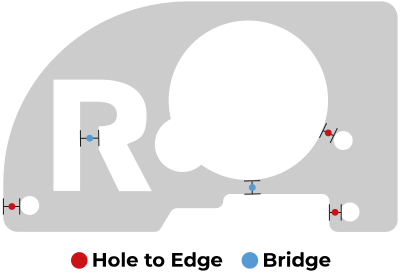
- Hole diameters should be greater than or equal to the thickness of the material.
- Keep holes at least 2× thickness away from edges.
- Oversize holes slightly if needed to accommodate material flex.
Design for mechanical fastening
UHMW does not bond with adhesives; use fasteners, interlocking features, or clamps.
Expect slight elastic movement
UHMW compresses and rebounds — avoid press fits or extremely tight alignment requirements. For more best practices: SendCutSend’s design guidelines
Where is UHMW most commonly used?
UHMW is used in demanding environments where constant wear, sliding friction, impact, or moisture would destroy other plastics. Typical applications include:
- Conveyor guides and wear strips
- Chutes, liners, and slide plates
- Bumpers and impact pads
- Marine components
- Agricultural equipment parts
- Snowplow and ice equipment wear shoes
- Industrial machinery guards
- Pulleys, rollers, and low-friction sliders
- Vibration isolation components
UHMW is an industrial staple especially in environments where heavy movement, abrasion, or debris are common.
Are UHMW parts from SendCutSend made in the USA?
UHMW at SendCutSend is sourced from U.S. suppliers, ensuring consistent sheet density, predictable machining behavior, and reliable performance across thicknesses. All CNC routing, inspection, and shipping of parts ordered through SendCutSend take place in our three U.S. facilities:
- Reno, Nevada
- Paris, Kentucky
- Arlington, Texas
This domestic workflow allows us to maintain fast lead times, tight tolerances, and stable material availability.
When should I use UHMW for my project?
Use UHMW when you need a tough, low-friction, abrasion-resistant material that can take years of sliding, impact, vibration, and heavy mechanical use. UHMW is ideal if your part must:
- Resist wear and abrasion
- Survive harsh industrial or outdoor environments
- Absorb impact without cracking
- Glide smoothly with minimal friction
- Handle chemicals, water, and debris
- Perform reliably with minimal maintenance
At SendCutSend, we CNC route USA-sourced UHMW to ±.005” accuracy in .375” and .500” thicknesses, giving you durable components built for long-term performance in the toughest applications.