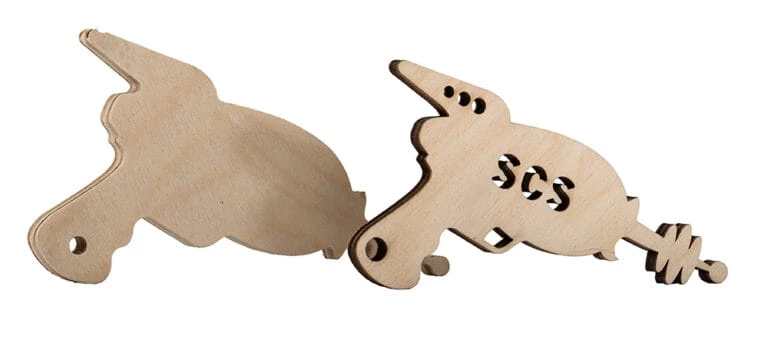
Baltic birch plywood: Clean, strong, laser-ready wood for fabrication, prototyping, and finished parts
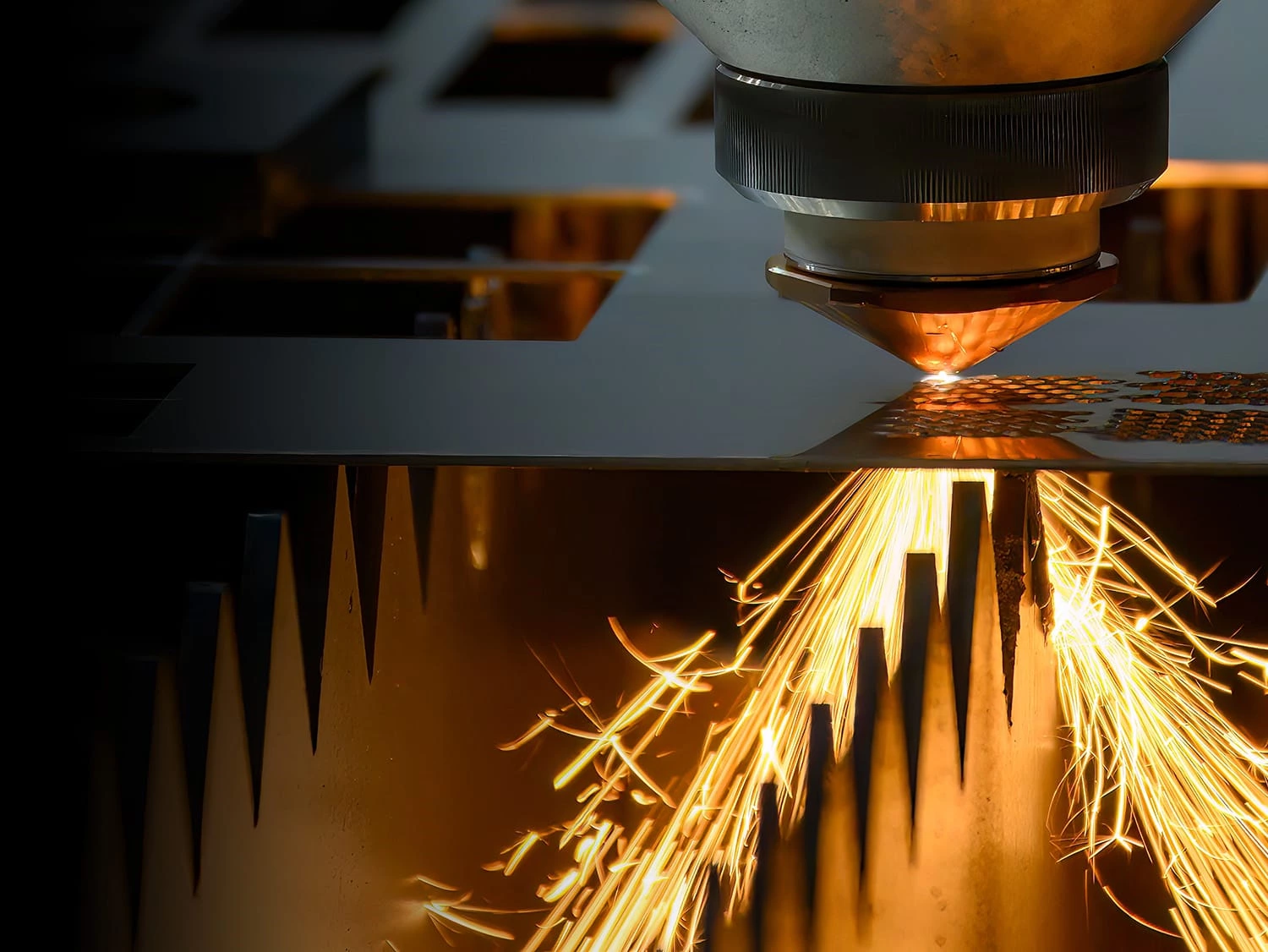
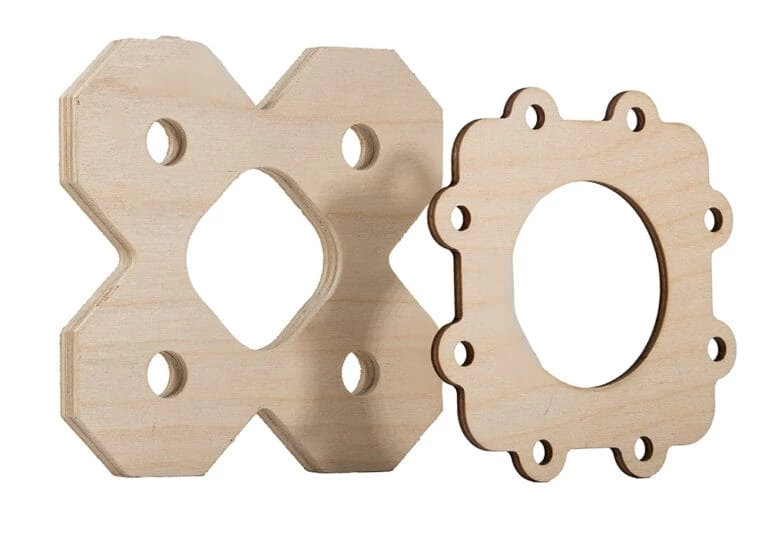
Baltic birch plywood is one of the most consistent and stable plywood options available for CNC routing and laser cutting. Unlike construction plywood, Baltic birch is made from multiple thin layers of birch veneer, giving it excellent strength, dimensional stability, and a clean, uniform appearance. Fabricators, makers, and engineers choose Baltic birch because it laser cuts beautifully, holds detail well, finishes easily, and is far more consistent than big-box plywood. Whether you’re building functional prototypes, custom enclosures, signage, decorative parts, or furniture components, Baltic birch offers durability and precision that typical plywood can’t match. At SendCutSend, we laser cut or CNC route globally-sourced Baltic birch plywood in .125″, .157″, .295″, and .472″ thicknesses, with cut method depending on thickness and geometry, all held to ±.005″ precision for routing and ±.009″ for laser cutting.
What are the key things to know about Baltic birch plywood?
- Stable and strong: multiple thin veneers result in excellent dimensional stability.
- Laser- and CNC-friendly: cuts cleaner and more predictably than typical plywoods.
- Attractive appearance: tight grain and uniform face veneers take stain and finish well.
- Low void core: fewer gaps inside the panel improve edge strength and cut consistency.
- Good for structural and decorative parts: strong enough for mechanical assemblies and clean enough for aesthetic projects.
Why do fabricators choose Baltic birch plywood for CNC and laser-cut projects?
Fabricators consistently choose Baltic birch because it is one of the few plywoods that behaves predictably during laser cutting. It has:
- Minimal voids that would otherwise cause blowouts or burnt pockets.
- Uniform inner plies, which help maintain strength along edges and small features.
- Stable, flat panels, making it reliable for tight-tolerance projects.
- A clean-burning veneer, reducing char and smoke compared to cheaper plywood.
- A professional-grade finish, ideal for products, prototypes, or production runs.
Baltic birch is widely preferred for:
- Enclosures and assemblies
- Furniture components
- Jigs and fixtures
- Router templates
- Structural prototypes
- Educational and maker projects
It bridges the gap between hobby plywood and hardwood — affordable, yet strong and clean enough for production parts.
How well does Baltic birch plywood laser cut?
Baltic birch cuts very well when the wood is high quality and consistently layered. Here’s what fabricators can expect:
Clean, sharp edges
Laser cutting produces darkened but crisp edges with minimal splintering.
Good detail capability
.125″ and .157″ birch can handle fine details, small holes, and intricate geometry much better than hardware-store ply.
Some edge darkening
Laser cutting burns through the glue layers, so edges will be dark. This is normal for plywood and can be sanded if needed.
Uniform cutting depth
Because Baltic birch has minimal voids, the laser doesn’t dip or flare unexpectedly.
Smoke marks on the underside (sometimes)
These are usually mild and can be cleaned with:
- Light sanding
- Denatured alcohol
- Painter’s tape masking during cutting (if user is cutting themselves)
SendCutSend optimizes settings to reduce burning and smoke, but some is inherent to all laser-cut wood. For thicker birch (.295” and .472”), CNC routing will be used when required for consistent quality.
When does SendCutSend use CNC routing instead of laser cutting for birch plywood?
At SendCutSend, the process depends on: Material thickness
- .125″ and .157″ → typically laser cut
- .295″ and .472″ → often CNC routed for quality and part integrity
Geometry If your part includes:
- Deep pockets
- Tight internal slots
- Chamfers or larger radii
- Very thick material
- Features that risk excessive burning SendCutSend will route instead of laser cut.
The quote builder automatically assigns the correct process for best results, so you don’t have to think about it when you use SendCutSend. You’ll simply get your Baltic birch parts fast!
What are the advantages of using Baltic birch plywood?
- Excellent dimensional stability
Because it uses many thin plies, birch resists warping better than standard plywood.
- Stronger than typical plywood
Its multi-ply core provides consistent strength in all directions — ideal for structural parts.
- Clean appearance
Smooth face veneers take stain, paint, and clear finish exceptionally well.
- Consistent laser performance
Few voids + uniform glue layers = predictable and clean cutting.
- Affordable and versatile
Less expensive than hardwood while offering better structural stability.
What are the limitations or drawbacks of Baltic birch plywood?
- Char and smoke are unavoidable with laser cutting
All plywood will produce dark edges and some residue due to glue content.
- Outer veneers are thin
Aggressive sanding can sand through the outer layer.
- Baltic birch is not weather-proof
For outdoor use, consider sealing orpainting Baltic birch, or switching to a weather-resistant material like
- Burn risk on very small features
Extremely thin “fingers” or micro-details may be fragile or burn away.
- Glue layer inconsistencies
Global supply varies. Some panels may have slightly darker or lighter glue lines internally.
How should I design parts for Baltic birch plywood?
- Avoid extremely thin features: Keep unsupported features thicker than:
-
- Add fillets to internal corners: This improves both routing and laser cut quality.
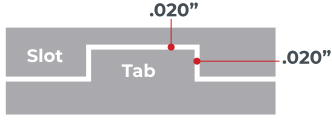
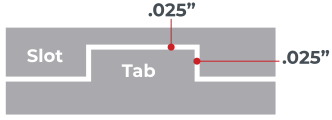
- Allow for tab/slot fit tolerances: Wood expands and contracts with humidity; laser kerf also affects friction fits.
- Plan for charred edges: If your application requires light-colored edges, sanding will be needed.
- Avoid over-tightening screws: Use washers and pilot holes to prevent splitting.
-
Check out SendCutSend design guidelines for further tips.
What are the most common uses for Baltic birch plywood?
Across CNC, laser cutting, woodworking, and maker communities, common applications include:
- Furniture components
- Laser cut artwork and décor
- Instrument parts and speaker cabinets
- Mechanical prototypes
- Jigs, fixtures, and templates
- Small enclosures and boxes
- Signage and lettering
- Cosplay and model-making
- Educational and STEM kits
It’s strong enough for mechanical use, clean enough for display, and consistent enough for mass production.
When should I use Baltic birch plywood for my project?
Choose Baltic birch plywood when you need a strong, stable, clean-cutting wood that works well for both functional and aesthetic applications. You should consider birch plywood if your part requires:
- High dimensional stability
- Strong, uniform internal layers
- Tight laser-cut features
- A smooth, attractive surface
- A balance of cost and performance
- Strength without extreme weight
Don’t choose birch plywood for:
- Outdoor applications (unless fully sealed)
- High-heat environments
- Heavy mechanical load-bearing requiring hardwood or metal
- Micro-details in extremely thin geometry
At SendCutSend, we laser cut or route Baltic birch plywood in four useful thicknesses with 2–4 day lead times, giving you high-quality, production-ready components for everything from furniture to hobby projects.